Best Time to Visit Arizona and the Grand Canyon
The desert's best season is the rim's coldest. A month-by-month guide to Arizona's three climates — low desert, high country and inner canyon — with the heat data most guides soft-pedal.
The short answer: late September through October, or April through May. Those two windows are the best time to visit both the Grand Canyon’s South Rim and Arizona’s low desert — mild temperatures, safe hiking, and in the fall a genuine drop in crowds. Broadly, mid-September through May works for both; June through early September is the season to avoid down in the desert.
Most guides get this wrong by treating Arizona as one climate. It is three. The low desert around Phoenix and Apache Junction sits at 1,000 to 2,500 feet; the high country — Flagstaff, Sedona, Payson, the Grand Canyon’s South Rim — sits at 4,500 to 7,000; and the inner canyon at Phantom Ranch drops to about 2,460. They run on opposite calendars. Phoenix’s most comfortable months are the rim’s coldest, and Phoenix’s dangerous months are when the mountains are glorious.
The other thing most guides soft-pedal is the heat. Phoenix set an all-time record of 113 consecutive days at or above 100°F in 2024, and Maricopa County confirmed 608 heat-related deaths that year. That is not a scenic inconvenience, and it is the honest reason most open-air desert tour operators around here — including the off-road outfitters at Goldfield — close or scale back from 1 June to 14 October.
The calendar above is the Apache Trail Histories and Mysteries One Day Van Tour — a new listing from Across Arizona Tours with no reviews on GetYourGuide yet, whose operator’s earlier steamboat day trip averaged 4.9 from more than 60. It is the one we point seasonal readers at because it does not depend on the Canyon Lake steamboat, which is suspended from 30 August 2026 until roughly January 2027 while the lake is drawn down. Prices and seasonal schedules move constantly out here; the calendar is always more current than this page.
The Core Answer, and the Three Climates
Target late September into October, or April into May. These shoulder windows deliver mild rim temperatures, safer inner-canyon hiking, good light and — especially in fall — a real dip in crowds. It is the near-universal recommendation of the National Park Service and of the operators who work the canyon every week.
South Rim monthly average high and low, °F (National Park Service):
| Jan | Feb | Mar | Apr | May | Jun | Jul | Aug | Sep | Oct | Nov | Dec | |
|---|---|---|---|---|---|---|---|---|---|---|---|---|
| High | 41 | 45 | 51 | 60 | 70 | 81 | 84 | 82 | 76 | 65 | 52 | 43 |
| Low | 18 | 21 | 25 | 32 | 39 | 47 | 54 | 53 | 47 | 36 | 27 | 20 |
Inner canyon at Phantom Ranch, monthly average high and low, °F (NPS):
| Jan | Feb | Mar | Apr | May | Jun | Jul | Aug | Sep | Oct | Nov | Dec | |
|---|---|---|---|---|---|---|---|---|---|---|---|---|
| High | 56 | 62 | 71 | 82 | 92 | 101 | 106 | 103 | 97 | 84 | 68 | 57 |
| Low | 36 | 42 | 48 | 56 | 63 | 72 | 78 | 75 | 69 | 58 | 46 | 37 |
Temperature rises about 5.5°F for every 1,000 feet you descend. The inner canyon averages 106°F in July and has hit 120°F at Phantom Ranch. That single fact is why the NPS warns against hiking to the river in summer, and why heat-exhaustion rescues are a daily summer occurrence.
Snow and rain. The South Rim averages 58 inches of snow a year; the North Rim averages 142; Phantom Ranch gets less than one. Annual precipitation on the South Rim is under 16 inches. The wettest rim months are the monsoon months of July (1.81") and August (2.25"), plus winter storms in December (1.64") and February (1.55").
Monsoon and lightning. Thunderstorms fall mainly in July, August and early September, described by the NPS as “extremely variable” and concentrated between 11 a.m. and 6 p.m. Lightning can strike up to ten miles from the rainfall producing it, and flash floods can reach the canyon bottom with no warning at all.
Daylight. Arizona stays on Mountain Standard Time year-round. At the summer solstice the South Rim gets about 14h 37m of daylight, sunrise around 5:12 a.m. and sunset around 7:48 p.m.; at the winter solstice about 9h 42m, sunrise 7:35 a.m. and sunset 5:17 p.m. Nearly five hours’ difference, which changes how much you can fit into a day more than the temperature does.
Best viewpoints by time of day. For sunrise, Mather Point and Yaki Point. For sunset, Hopi Point is the classic and the most crowded; Yaki, Pima and Mohave Points are less congested. The Hermit Road viewpoints — Hopi, Mohave, Pima — are shuttle-only from March through November.
Best day of week. Crowds thin sharply midweek. Go Tuesday through Thursday, and get to the gate as early as you can to beat both the entrance queue and the parking-lot fill.
North Rim, 2026 status. Normally open mid-May to mid-October. After the Dragon Bravo Fire — lightning-ignited on 4 July 2025, burning 145,504 acres and destroying 113 structures including the historic Grand Canyon Lodge, the North Rim Visitor Center and dozens of cabins — the North Rim is on an adaptive, limited-services reopening. The paved roads (Highway 67, Cape Royal, Point Imperial) reopened on 15 May 2026, but there is no lodging, no potable water in the developed area, and limited food and fuel. Confirm status with the NPS before building any trip around it.
Grand Canyon West and the Skywalk. On Hualapai tribal land at about 4,000 feet, not part of the national park, and four to five hours from the South Rim. Open 365 days a year, roughly 8 a.m.–5 p.m. in winter and 7 a.m.–7 p.m. in summer. It is the warmest of the three rims — summer highs above 100°F, winter highs in the 50s — so late fall through spring is its best window.
Other Experiences You Might Enjoy
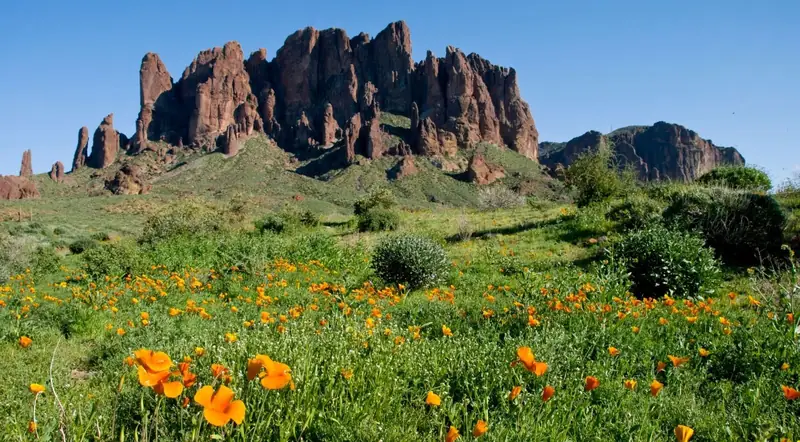
The seasonal highlights here are specific places: Lost Dutchman State Park for spring wildflowers, Goldfield Ghost Town in the cool months, the Salt River in summer, Sedona for October colour, and the Apache Trail from October to May:
Grand Canyon Crowds by Month
The Grand Canyon drew 4,919,163 recreation visits in 2024, up about 4% on 2023’s 4.73 million, ranking third among U.S. national parks behind Great Smoky Mountains and Zion — and still below its 2019 peak.
It has the flattest crowd curve of any major park, because the South Rim is open and staffed every single day. On a five-year monthly average from 2021 to 2025, July is busiest at about 531,000 visits and January quietest at about 169,000, roughly 32% of peak. April through October all sit above 80% of peak, so “off season” in the usual sense barely exists here.
Crowding shows up as entrance-station queues, parking lots full by mid-morning, shuttle-bus waits and scarce in-park lodging — Phantom Ranch books up to 13 months out. Spring break in March, the whole summer, and holiday weekends produce the sharpest surges.
The sweet spot, precisely. Late September into the third week of October: the September dip in visitation lands on still-warm days, softer light, and the North Rim’s late-season colour before it closes in mid-October. May is the spring equivalent — after the winter cold and before both the summer heat and the July crowd peak.
Month by Month Across Arizona
Phoenix’s climate runs opposite to the mountains’: its comfortable season, October through April, is the mountains’ cold season, and its dangerous season, May through September, is when the high country is at its best.
For reference, Phoenix normals from 1991–2020 (NWS) put July as the hottest month at a normal high of 106.5°F, with the low desert regularly clearing 100°F from May through September. Flagstaff averages a July high of about 83°F and a January high of about 43°F, with roughly 81 inches of snow a year on the same normals period.
January. Low desert: peak season — sunny, highs in the mid-60s, cool nights. High country and rim: cold and snowy, South Rim highs around 41°F, Flagstaff under snowpack. Best for snowbird-perfect desert weather, clear desert air, and the year’s clearest canyon visibility. Watch for high-country road ice. Events: VRBO Fiesta Bowl (8 Jan 2026), Barrett-Jackson Scottsdale (17–25 Jan 2026), Arizona Renaissance Festival opens (31 Jan 2026). Crowds and prices high and rising. Verdict: prime desert month, cold up north.
February. Low desert: arguably the best all-around desert month — highs in the upper 60s to low 70s, wildflowers beginning. High country: still winter. Best for spring training, the first wildflowers and perfect desert hiking. The catch is price: this is the year’s most expensive month, with Scottsdale GSA lodging peaking at $229 a night. Events: WM Phoenix Open (2–8 Feb 2026, around 600,000 fans), Scottsdale Arabian Horse Show (12–22 Feb 2026), Cactus League opens (20 Feb 2026), Lost Dutchman Days rodeo in Apache Junction (27 Feb–1 Mar 2026). Verdict: the desert’s peak — book well ahead.
March. Low desert: warm, highs in the upper 70s to low 80s, wildflowers at their peak, and the first triple-digit days possible late in the month. High country: snow melting, shoulder season. Best for wildflowers, spring training and the Renaissance Festival. Spring-break crowds and prices bite, and the Grand Canyon gets its own spring-break spike. Verdict: gorgeous, crowded and pricey.
April. Low desert: the last comfortable month, highs in the low-to-mid 80s and climbing; saguaros start blooming late in the month. High country and rim: excellent — South Rim highs around 60°F, prime rim hiking, and an inner canyon that is warm but not yet deadly. Nothing significant to avoid. Crowds still elevated but easing. Verdict: the best statewide balance of the year.
May. Low desert: heat arrives, highs in the low-to-mid 90s and beyond. High country and rim: outstanding — South Rim highs around 70°F, dry and clear, and the North Rim reopens (15 May 2026, limited services). Best for rim hiking, high-country wildflowers and pre-summer canyon crowds. Avoid low-desert exertion at midday. Salt River tubing opens 25 April 2026. Desert rates fall sharply. Verdict: pivot upcountry — superb for the canyon.
June. Low desert: dangerous heat, highs of 101°F and climbing, and the driest, lowest-humidity stretch of the year. High country: near-perfect — Flagstaff, Prescott and Payson in the 80s, Sedona in the upper 80s. Best for escaping to the mountains and rivers; the saguaro bloom peaks in early June. Avoid all midday low-desert activity. Monsoon season officially begins 15 June. The desert hits its price trough with deep resort discounts. Verdict: mountains yes, desert no.
July. Low desert: peak danger — Phoenix normal high 106.5°F, plus monsoon storms. High country: warm days and spectacular monsoon skies with afternoon storms. Inner canyon: 106°F average high — do not go below the rim. Best for monsoon photography, high-country escapes and water recreation. The Grand Canyon’s busiest month. Verdict: survive the desert, enjoy the pines.
August. Low desert: still brutal. Rim: the wettest monsoon month. High country: monsoon continues, lush and green. Best for monsoon drama and the green desert after storms. Stay out of flash-flood zones and slot canyons when storms are building. Desert value season. Verdict: like July — go high or go wet.
September. Low desert: the heat breaks late in the month, still hot early. High country and rim: the overall winner — South Rim highs around 76°F, crowds down about a third from summer, and early colour arriving. Avoid the early-month desert heat and the lingering monsoon. Verdict: the best single month for the Grand Canyon.
October. Low desert: comfortable again by mid-month, highs in the 80s to low 90s early then cooling; the Goldfield off-road operators reopen 15 October. High country: peak fall colour — Flagstaff in early October, Sedona and Oak Creek Canyon roughly 20 October to 10 November. Best for the statewide sweet spot returning, and for ghost-town and Halloween season at Goldfield. The North Rim closes mid-month. Crowds moderate. Verdict: the fall sweet spot — everything aligns.
November. Low desert: excellent, highs in the low 70s, snowbirds arriving. High country and rim: cold and quiet, South Rim highs around 52°F. Best for Thanksgiving at the resorts, a quiet canyon and a mild desert. Watch for high-country cold snaps. Events: Día de los Muertos in early November. Crowds and prices rise into the holidays. Verdict: the most underrated desert month.
December. Low desert: cool and clear, highs in the mid-60s. High country and rim: winter, snow, and festive. Best for holiday events, snow play up north and the clearest desert skies of the year. Avoid high-country driving in storms. Events: Tempe Festival of the Arts (4–6 Dec 2026). Holiday spike late in the month. Verdict: cosy desert winter begins.
The Heat Reality
This is the section most travel guides skip, and it is the one that should change your plans.
- 2023: a record 31 consecutive days at or above 110°F, obliterating the previous record of 18 set in 1974. The summer killed more than 600 people in Maricopa County.
- 2024: a record 113 consecutive days at or above 100°F (27 May to 17 September), smashing the 1993 record of 76. Also 61 days at or above 110°F, beating 2023’s 55. The June-to-August average of about 99°F made it Phoenix’s hottest summer on record, roughly 2°F above 2023. As NWS Phoenix meteorologist Matt Salerno put it: “It’s very rare that we see, especially two summers in a row, two record breaking summers like we just experienced.”
- Heat-associated deaths, Maricopa County Department of Public Health: 645 in 2023, a record and a 52% jump on 2022 — “the most heat related deaths ever” recorded. 608 confirmed in 2024 in the final report, the first year-over-year decrease since 2014. 430 in 2025, a second consecutive decline.
In 2024 a heat-related death occurred every single day from 18 June to 31 July — 355 deaths across that 44-day stretch. Most victims are locals: older adults, people experiencing homelessness, people with substance-use disorders. But unacclimated visitors are at real risk on trails, and that is the group this page is written for.
NWS Excessive Heat and Extreme Heat Warnings mean conditions dangerous to anyone without cooling and hydration. On days with an Extreme Heat Warning, the City of Phoenix closes its most dangerous popular trails — Camelback via Echo Canyon and Cholla, the Piestewa Peak summit, and parts of South Mountain — from 8 a.m. to 5 p.m. In 2024 the city closed trails on 45 days between 1 May and 13 October; that stretch contained 121 days at 105°F or above and 69 days above 110°F.
What stays safe and genuinely pleasant in summer: water recreation on the Salt River and the lakes, higher elevations — Flagstaff, Prescott, the Mogollon Rim, both canyon rims — indoor attractions, and outdoor activity confined to dawn. The Salt River kayak float is the local answer to a July afternoon: 4.9/5 from 2,843 reviewers, from $57, and on the water rather than beside it.
This is also the honest, non-defensive reason the Goldfield-based off-road operators and most Sonoran Desert 4x4 outfits close or scale back from 1 June to 14 October. Open-air desert touring at 110°F is neither safe nor enjoyable, and the trails and lakes those tours use are at their least hospitable then. Our Sonoran Desert and Superstition Mountain guide covers the physiology of desert heat and what to carry.
Monsoon Season
Official dates: 15 June to 30 September, fixed by the National Weather Service in 2008. Before that the start was tied to three consecutive days with a dewpoint of 55°F or higher. In practice storms rarely ramp up before early-to-mid July, and August is usually the busiest month.
How it works. Summer heating builds a high-pressure ridge over the Four Corners; winds shift from dry westerlies to moist southerlies, drawing moisture up from the Gulf of California and the Gulf of Mexico. Intense surface heating then fuels afternoon-to-evening thunderstorms, mostly between 11 a.m. and 6 p.m. Phoenix gets somewhere between a third and half of its annual rain in this window.
What it means for a visitor:
- Haboobs. Walls of dust that cut visibility to zero. The official guidance is “Pull Aside, Stay Alive”: get off the road, stop, turn your lights off, and take your foot off the brake so following drivers don’t steer toward your tail lights.
- Flash floods. You can lose control of a vehicle in six inches of moving water, and most vehicles float in two feet. Never enter a flooded wash.
- Lightning. It can strike ten miles from the rainfall. Leave exposed rim viewpoints when storms approach.
- Unpaved roads. The Apache Trail’s Fish Creek Hill section and other dirt roads turn hazardous or impassable when wet — see our road conditions guide for how to check before you drive.
- The upside. The monsoon produces Arizona’s most dramatic photography: towering thunderheads, lightning over the buttes, rainbows, and a desert that turns genuinely green.
Wildflower and Bloom Season
Desert wildflowers typically bloom late February to April, peaking in March at low elevations. A true superbloom needs well-timed, abundant fall and early-winter rain — a couple of good soaks. A dry winter, as in 2025, yields sparse annuals, though hardier perennials like brittlebush and globemallow still show. The 2026 season came early after a wet fall and winter, then was cut short by an early-March heat wave that dried out the fragile poppies at Picacho Peak.
Bloom windows: Mexican gold poppies and lupines in February and March at low elevation; brittlebush, ocotillo and palo verde through spring; saguaro from late April to early June, with the white crown flowers peaking around May; prickly pear in May.
Where to see it near Phoenix: Lost Dutchman State Park in the Superstitions, Picacho Peak State Park, Boyce Thompson Arboretum, Peridot Mesa and Bartlett Lake Road.
Check before you drive. The Arizona State Parks Wildflower Bloomdar at azstateparks.com/wildflowers has a dedicated Picacho Peak page, the Desert Botanical Garden tracks the Phoenix-area bloom, and the University of Arizona’s DroughtView satellite tool shows greening across the state.
What to Do When: A Seasonal Activity Matrix
- Low-desert hiking: October–April. Avoid midday May–September, and heed the Phoenix trail closures.
- High-country and rim hiking: May–October.
- Inner-canyon hiking and backpacking: March–May and September–October. Never midday in summer.
- Salt River tubing: roughly 25 April to late September 2026.
- Lakes — Canyon Lake, Saguaro Lake: spring and early summer are best, subject to the 2026 Canyon Lake closure below.
- Skiing at Arizona Snowbowl and Sunrise Park: roughly mid-December to early April, snow-dependent.
- Fall colour: Flagstaff aspens late September to early October; the Mogollon Rim mid-October; Sedona and Oak Creek Canyon 20 October to 10 November, peaking near 1 November; the southern sky islands mid-November; Boyce Thompson Arboretum late November.
- Stargazing and the Milky Way: core season roughly April–October. The Grand Canyon and Flagstaff, a designated Dark Sky city, are the premier spots.
- Wildlife and birding: spring and fall migrations; elk bugling in the high country in September and October.
- Snowbird season: roughly November–April, when part-time residents swell the Valley. Expect heavier traffic, longer restaurant waits and higher prices.
Prices and Crowds by Season
Phoenix and Scottsdale hotels run a bimodal year: a strong peak from roughly January to April, a hard trough from June to August, and shoulder months in May and from October to December.
The GSA per diem illustrates the swing plainly — lodging peaks at $229 a night in February and bottoms at $113 in June. Vacation-rental operators describe the same four tiers: peak from mid-January through March, shoulder in April and October–December, soft in May and September, low from June to August.
The spikes to plan around are Barrett-Jackson in mid-to-late January and the combination of the WM Phoenix Open, the Scottsdale Arabian Horse Show and spring training in February and March. Those weeks produce the year’s highest rates and tightest availability — book three to four months ahead.
Summer deals are real. Resorts pivot to steep discounts and staycation pricing from June to August. Tour availability and pricing follow the same curve: the October-to-May operating season aligns with the comfortable, higher-demand months, and the 1 June to 14 October closure sits squarely in the trough.
The Apache Trail and Superstition Seasonal Picture
Apache Junction and the Superstitions track the low desert closely, and October to May is the sweet spot.
- Temperatures are comfortable from October to April at 65–85°F daytime, heat through May, and become dangerous from June to September.
- The Apache Trail (SR-88) is most pleasant October to April. Monsoon rain can make the unpaved Fish Creek Hill section hazardous in summer. Our self-drive guide covers which sections each type of vehicle can handle.
- Canyon Lake is at its best in spring and early summer for scenery and bighorn sheep — but in 2026 the lake closes on 8 September, with Tonto National Forest shutting every ramp and access point, and a 16-week SRP drawdown lowering the lake about 54 feet from 16 September 2026. The Dolly Steamboat suspends operations on 30 August 2026 until roughly January 2027. Plan any lake-based part of a trip around those dates; our Canyon Lake visitor guide has the full detail.
- Green desert and wildflowers are best after winter and monsoon rains; local wildflowers at Lost Dutchman State Park peak in February and March.
- Off-road conditions are best in the cool, dry months from October to May, which is also when the short Superstition off-road tours run. The Bulldog Canyon Off-Road Adventure is the one that actually gets into Superstition back country, in the Tonto National Forest permit zone — 5.0/5 from 116 reviewers, from $150. Our off-road and Jeep tour guide compares what each format costs.
Why the June-to-October closure exists. Those are the low desert’s hottest, most dangerous and lowest-demand months, when open-air 4x4 touring is unpleasant and unsafe, monsoon can close trails, and Canyon Lake and Apache Trail conditions are at their worst. Reopening on 15 October lines up with the return of comfortable weather and the fall sweet spot. If you want the Apache Trail specifically rather than Arizona broadly, our month-by-month Apache Trail guide narrows all of this to the corridor itself.
Who Should Visit When
- Families tied to school breaks. Summer is the low desert’s worst window — go high country to Flagstaff, the rims and the Rim lakes, and build the days around water. Fallback: spring break in March, with early-morning desert plans and everything booked in advance.
- Retirees and snowbirds. November through April in the desert. Fallback: the October and May shoulders for lower prices.
- Hikers and backpackers. Inner canyon and desert in March–May or September–October; high country June–September. Fallback: winter desert hiking, which is cool and quiet.
- Photographers. Monsoon in July and August for dramatic skies; winter for the clearest canyon air and snow contrast; fall for Oak Creek colour. Fallback: golden hour on any clear shoulder-season day.
- Budget travellers. June through August for rock-bottom desert resort rates, accepting the heat and staying pool- and dawn-focused. Fallback: the May and September shoulders.
- International visitors. October through April for the desert; May through October to combine the canyon and the high country.
- Crowd-avoiders. November through February at the Grand Canyon, and midweek always. Fallback: late September at the canyon, or summer weekdays in the high country.
Frequently Asked Questions
What is the single best month to visit Arizona? April, for the whole state at once — the desert is still comfortable, the rim is prime for hiking, and the inner canyon is warm without being dangerous. If the Grand Canyon is the priority rather than the state, September wins.
What is the best time of day at the Grand Canyon? Sunrise at Mather Point or Yaki Point, sunset at Hopi Point if you don’t mind crowds or Yaki, Pima and Mohave if you do. Early morning also beats the entrance queue and the parking-lot fill.
What is the best day of the week to go? Tuesday through Thursday. Crowds thin sharply midweek at every season.
Is it too hot to visit Phoenix in summer? For outdoor activity, effectively yes. Phoenix ran 113 consecutive days at 100°F or above in 2024 and the city closes its most dangerous trails on Extreme Heat Warning days. Summer is viable if you plan around water, altitude, air conditioning and dawn — and it is the cheapest season by a wide margin.
When do desert wildflowers bloom? Late February to April, peaking in March at low elevations. Saguaros flower from late April to early June. A superbloom needs a wet fall and early winter, so check the Arizona State Parks Bloomdar before making a trip of it.
What is monsoon season and does it ruin a trip? 15 June to 30 September officially, with most storm activity in July and August between 11 a.m. and 6 p.m. It does not ruin a trip — it produces the best photography of the year — but it means dust storms, flash floods, lightning and unpaved roads that turn impassable.
When is the cheapest time to visit? June through August, when Phoenix and Scottsdale resort rates hit their trough. The GSA lodging per diem falls from $229 a night in February to $113 in June.
Is the Grand Canyon open in winter? The South Rim is open year-round, with highs in the 40s, snow on the ground and icy trails. It is the quietest and cheapest season, and the clearest air of the year. The North Rim is closed in winter and running on limited services even in season after the 2025 fire.
When should I visit the Apache Trail and Canyon Lake? October through May. In 2026 add the closures: Canyon Lake shuts on 8 September for a 16-week drawdown, and the Dolly Steamboat suspends cruises from 30 August until about January 2027.
Bottom Line
If you can pick your dates freely, go in April or late September to October. Those are the two windows where the low desert, the high country and the canyon rim are all pleasant at the same time, and where you are not trading comfort for crowds or crowds for comfort.
If your dates are fixed, work with the split rather than against it. Winter and early spring belong to the desert; June to September belong to the mountains, the rims and the water. Trying to do the Superstitions in July or the North Rim in January is how a good trip becomes a bad one.
And if you are here in summer anyway, go early, go high, or go on the water — and take the heat data seriously, because it is the one thing on this page that has actually killed people.
Planning a canyon trip out of the Valley? Our honest guide to the Phoenix–Grand Canyon day trip does the drive-time arithmetic. If you would rather stay close, compare the Apache Trail tours or start with the featured day tour — and check the calendar above for what is actually running this month.
The Superstitions, Goldfield and a Lake Cruise in One Day
Hotel pickup, a local guide and a group of five or fewer, with Goldfield Ghost Town and a 90-minute cruise on Saguaro Lake. The cruise ticket, about $34, is bought separately after booking, and at least two adults must book. Free cancellation up to 24 hours before.
Check Availability & Book