Arizona Ghost Town & Gold Mining Tours
Goldfield Ghost Town, the Lost Dutchman legend, gold panning law, mine safety, and the Arizona ghost towns worth the drive — with honest answers about what's original and what's rebuilt.
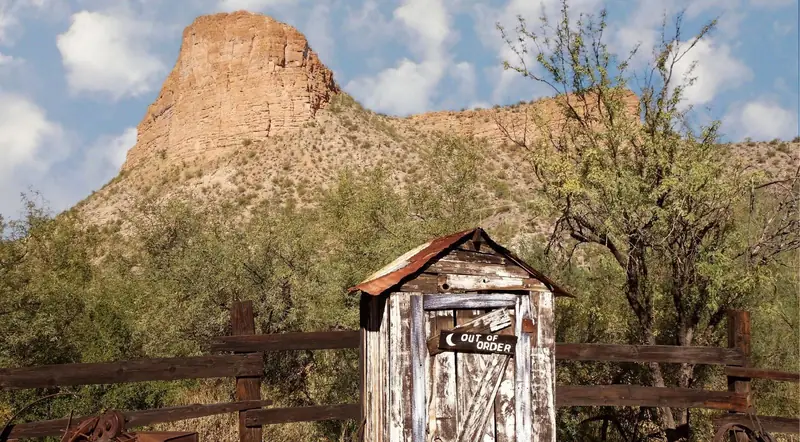
Arizona has an estimated 275-plus ghost towns and mining camps, and roughly 100,000 abandoned mines. Only a handful of those are places you can actually visit, fewer still let you walk into a mine tunnel of any kind, and exactly one sits four miles up the Apache Trail with a narrow-gauge railroad, a working saloon and a mine tour on the main street.
This guide is about all of them — starting with Goldfield, because it is the most accessible and the most misrepresented, then working outward to Jerome, Tombstone, Bisbee, Vulture City and the rest. It also covers the two things that most ghost-town articles skip entirely: what the law actually permits when it comes to gold panning and picking things up, and why walking into an abandoned mine on your own is one of the more reliably fatal things you can do in this state.
The tour above is the one that covers the most ground for anyone whose interest is specifically the mining history: the Apache Trail Histories and Mysteries One Day Van Tour includes the Mammoth Gold Mine tunnel tour, the Goldfield Museum, the narrow-gauge railroad, and the Superstition Mountain Museum with the Apacheland Barn and Elvis Chapel, plus Weaver’s Needle and lunch at Tortilla Flat. It is a new listing from Across Arizona Tours with no reviews on GetYourGuide yet; the same operator’s earlier steamboat day trip, since withdrawn, averaged 4.9 from more than 60 reviews.
Goldfield Ghost Town: A Reconstruction on a Real Townsite
Let’s be straight about this first, because most articles get it wrong: today’s Goldfield is a reconstruction built on the original townsite, reusing some original foundations. It is not a preserved collection of surviving 1890s structures. When Bob Schoose first walked the site, per local historian Tom Kollenborn, “all that remained of the old settlement was a few old foundations, a rickety water tower, a rambling old shack used for a living quarters, and a small metal building.” That wooden water tower is among the few elements dating to the boom era.
And the mine tour is a reconstruction too — this is the detail nobody publishes. Goldfield markets the Mammoth Gold Mine tour as “an underground guided tour,” and it is genuinely good. But Kollenborn, writing for the Apache Junction Public Library, describes Schoose building it from scratch starting in 1985: “He did not go underground with his tunnel because of insurance restraints. His entire tunnel and mine were actually created above the ground, but made to appear below the ground. His reconstructed mine cage, tunnel, and stope appeared as real as reality itself.” The tunnel and the first snack bar opened in December 1988.
None of that is a reason to skip it. It is a reason to know what you are buying: a well-made interpretation of a real place and a real industry, on the ground where both happened — not a preserved ruin, and not a working shaft. If you specifically want to descend into an authentic mine, that is Bisbee’s Queen Mine or Tombstone’s Good Enough, both covered further down. Framed honestly, Goldfield holds up better than the oversold “authentic ghost town” competition.
Goldfield sits on a hill between the Superstition and Goldfield Mountains on the Apache Trail (SR-88), at 4650 N Mammoth Mine Rd, Apache Junction, AZ 85119. High-grade gold ore was discovered in 1892 by prospectors generally named as Collin Hakes, Riley Morse, and the Merrill brothers. The town received its first post office on October 7, 1893, and quickly grew to support three saloons, a boarding house, a general store, a brewery, a blacksmith, a butcher and a schoolhouse.
Peak population is genuinely disputed, and you should be suspicious of any article that gives you one number. The oldest source is also the most conservative: the historical marker erected in 1947 at the Bluebird Mine, 300 feet from the old workings, reads “During its heyday from 1893 to 1898 when $1,000,000 in gold was mined from this area about 300 people dwelt here.” Later popular sources inflate that considerably — around 1,500 in some accounts, up to 4,000 in others (Legends of America, Roadside America), with Roadside America noting the original town “peak[ed] at 28 buildings, with a community of up to 4,000.”
Twenty-eight buildings do not house four thousand people. Goldfield’s own operators describe the 1890s town as three saloons, a boarding house, a general store, blacksmith, brewery, meat market and a schoolhouse, and notably publish no population figure at all. Our reading: the 1947 marker’s ~300 is the best-supported number for permanent residents, the higher figures likely fold in the transient district-wide mining population, and anyone quoting 4,000 as a flat fact is repeating a tourism-brochure number.
The boom was short. The vein faulted along the Mammoth Fault, ore grade dropped, and the town died; the post office closed November 2, 1898. A revival ran roughly 1910–1926 under George U. Young, a former Secretary of Arizona Territory and acting governor, who formed the Young Mines Company, brought in eastern investors, and built a 10-stamp mill, a 50-ton cyanide plant, an electric power plant and worker housing. A second post office opened June 8, 1921, under the name “Youngsberg,” and closed October 30, 1926. A 1943 fire — reportedly started by an errant military training flare — destroyed roughly 60% of what remained. Bob Schoose and his wife Lou Ann bought the five-acre Goldfield mill site from Hub McErachan in early 1984 and began rebuilding: the mine tunnel and first snack bar opened in December 1988, the Blue Nugget and the Mammoth Saloon and Steak House in 1990, and the general store in 1991. Construction on the Goldfield Museum began in 1989, built by Schoose for the Superstition Mountain Historical Society in what Kollenborn calls “almost a donation of the building to the museum.”
Gold production figures conflict, so here they are with their sources attached. The best-documented total district figure, from Kilbey’s 1986 Arizona State University master’s thesis, is 60,226 ounces of gold and 21,402 ounces of silver between 1893 and 1986 — corroborated by a separate estimate of about 61,000 ounces of gold and 22,000 of silver. Period-dollar figures reported by mining historian William Ascarza in the Arizona Daily Star include a reported $170,000 in early Goldfield-district and Mammoth Mine value, and $67,000 worth of gold and silver from 7,100 tons of ore during the Young Mines years (Kollenborn puts the Young figure at “about $70,000 … according to some reports”).
Two disambiguations worth carrying with you, because both trip up otherwise careful writing. Do not confuse the Goldfield-area Mammoth Mine (the Young Mine / Mammoth group) with the far larger Mammoth–St. Anthony Mine at Tiger, about 50 miles north-northeast of Tucson, which produced over 150,000 ounces of gold. And do not confuse Arizona’s Goldfield with Goldfield, Nevada, which produced roughly 4.2 million ounces.
What You Can Actually Do at Goldfield
Entry and parking are free. You pay per attraction, which makes this an unusually easy place to visit on a half-budget — you can walk the street, watch a gunfight and buy nothing.
Prices below are the operator’s own published rates, checked against goldfieldghosttown.com in August 2026. Several have moved since the figures that circulate on travel blogs — the train in particular is no longer a $7 ride.
| Attraction | Price (Aug 2026) | Notes |
|---|---|---|
| Entry and parking | Free | Pay per attraction |
| Goldfield Mine Tour | $12 adult, $10 senior, $8 child 5–12, 4 and under free | ~25 minutes, guided; open 7 days. A reconstructed tunnel, not a working shaft — see above |
| Superstition Narrow Gauge Railroad | $12 adult, $10 senior, $8 child 5–12, 4 and under free | Arizona’s only operating narrow-gauge railroad; 1.5 miles of track circling the town, 20-minute narrated journey, departs every 35 minutes |
| Superstition Zipline | $15 per person | Town views from about 115 feet; (480) 982-0075 |
| Goldfield’s Walking Ghost Tour | $35 adult, $32 senior, $25 child | Nighttime, with host Matt Mason, about 1 hour 45 minutes; reservations at fearfrontier.net |
| Fear Frontier: Spirits of the Bordello | $13 adult, $11 senior, $9 child | Daytime, 10am–5pm, 30–35 minutes, entirely indoors and air-conditioned |
| Three-pack combo (train + mine + Mystery Shack) | Discounted bundle | The usual best value if you want all three |
| Goldfield Gunfighters | Free | Staged gunfights on the main street, primarily weekends |
| Goldfield Museum · Mystery Shack · reptile exhibit · gold panning | Not published online | Historically ~$7 museum, ~$9 Mystery Shack, ~$7 reptile exhibit, panning bags from just under $10 — call (480) 983-0333 to confirm |
Hours, per the operator: merchants 10am–5pm, the coffee shop 9am–4:30pm, the train and mine tours 10am–5pm seven days a week, and the Saloon daily with summer hours that vary — call ahead. (Blogs still quote a flat 11am–9pm saloon and a 9am–5pm bakery; neither matches what the operator publishes now.) Horseback riding is available separately through Superstition’s O.K. Corral Stables, hourly to all-day. Field trips run October through May by prior booking.
All of this shifts seasonally. The figures above were correct in August 2026 and are worth a phone call if you are building a tight schedule around them.
Several Apache Trail day tours build Goldfield into a longer itinerary, which is the low-effort way to see it if you are staying in Phoenix or Scottsdale without a car. The From Scottsdale/Phoenix: Apache Trail Day Tour allocates 80 minutes at Goldfield and includes Lost Dutchman Museum admission (a new listing with no reviews yet; see our what to know before you book it), and the Apache Trail Tour & Canyon Lake Cruise pairs it with a narrated cruise that its itinerary now runs on Saguaro Lake rather than Canyon Lake, plus admissions for the optional activities at Goldfield (4.9/5 from 27). Our hour-by-hour breakdown of an Apache Trail day tour shows where the ghost town falls in a typical day, and the full tour page has the pickup details.
Other Experiences You Might Enjoy
Beyond the ghost town itself, this corner of Arizona packs in a lot within an hour of Phoenix: the Superstition Mountains and Weaver’s Needle, the Mammoth Gold Mine tunnels under Goldfield, Canyon Lake and the Dolly Steamboat, the stagecoach-era saloon at Tortilla Flat, the Superstition Mountain Lost Dutchman Museum with its 20-stamp gold mill, and off-road routes into the Tonto National Forest backcountry. A few more ways to spend the day:
The Lost Dutchman Legend — and What the Geology Actually Says
Jacob Waltz, “the Dutchman” — a German immigrant, not a Dutchman — died on October 25, 1891 in Phoenix after falling ill following a flood, nursed by Julia Thomas, a Phoenix bakery owner. On his deathbed he reportedly described a fabulously rich gold mine in the Superstitions and left roughly 48 pounds of rich gold ore. Thomas, with Rhinehart and Herman Petrasch, mounted the first expedition to find it and failed; she later died penniless. The Peralta family legends, the Peralta Stones and Weaver’s Needle as the key landmark were largely popularized after Waltz’s death, notably by an 1895 San Francisco Chronicle story that first linked the Peraltas, Waltz and the Needle together.
Adolph Ruth, a 66-year-old treasure hunter from Washington, D.C., was packed into West Boulder Canyon around June 14, 1931, and vanished; he was reported missing on June 20. His skull was found on December 10, 1931 near the Three Red Hills by an Arizona Republic-sponsored expedition, and his skeletal remains on January 8, 1932 on the east slope of Black Top Mesa.
The murder story that made the legend rests on anthropologist Aleš Hrdlička, who is widely quoted — via Curt Gentry, and from there onto Wikipedia and a hundred ghost-tour scripts — saying that “a shotgun or high-powered rifle had been fired through the head at almost point-blank range.” That version does not survive contact with the record, and it is worth spelling out why, because it is repeated everywhere as settled fact:
- Hrdlička examined the skull on December 19, 1931 and, per Tom Kollenborn’s account, could not be positive the holes were bullet holes at all. He revised to “murder was possible” only after Ruth’s son pressed the foul-play theory — and he never signed the statement drawn up for him by Olive S. Taylor. The Apache Junction Public Library describes the gunshot report flatly as “unsigned, unverified” and notes it “has never been accepted by Arizona authorities.”
- Hrdlička was a physical anthropologist, not a forensic pathologist. Kollenborn is blunt that he “very much lacked the professional training to determine if the holes in Ruth’s skull were bullet holes.”
- The Maricopa County Sheriff’s Office had two physicians examine the remains in Phoenix. Both reported no signs of foul play. Both Maricopa and Pinal counties ruled natural causes — thirst, exhaustion and starvation.
- The separated skull, the detail that reads most sinister, has an ordinary explanation: Ruth’s clothing “had been shredded and spread over the area by wild animals,” while his personal effects were found intact.
So: a 66-year-old man walked into the Superstitions in mid-June, in heat that kills people every year, and died of it. The sensational Depression-era coverage did the rest. We are not going to tell you it is an open case when the only evidence for murder is an unsigned note from the wrong kind of specialist.
How many have died searching? Figures here are unreliable and worth hedging. The most defensible published number is that more than 30 people have died exploring the 160,000-acre Superstition Wilderness (Courthouse News, citing the wilderness area as a whole). Folklore and ghost-tour sites claim 300 to 600 and more. Treat those as legend.
Now the part almost nobody with a tourism interest will tell you. The federal USGS Professional Paper 1300 (1984) mineral assessment of the Superstition Wilderness concluded that “most of the Superstition Wilderness and adjoining areas are judged to have little promise for occurrence of mineral resources,” with only a narrow zone near the southern margin — tied to Arizona’s regional copper belt — having probable mineral-resource potential. The range is a volcanic caldera complex, the Superstition Cauldron Complex described by M.F. Sheridan in 1978, built of dacite and rhyolite tuff — geology that is generally unfavorable for large gold-bearing veins. As one field write-up relaying Sheridan and Arizona Geological Survey work puts it: “It is in the Goldfields that almost all of the gold and silver in the area has been extracted — not in the fabled Superstitions.”
In plain terms: a rich Lost Dutchman vein inside the volcanic peaks is geologically improbable, and the real historic gold came from the Goldfield district on the northwest flank. That does not make the legend less interesting. It makes it a better story, and it should make you extremely skeptical of anyone selling a map.
The Superstition Mountain Lost Dutchman Museum at 4087 E Apache Trail, Apache Junction, is where to go if the legend is what brought you. It is a 15-acre campus with the Apacheland Barn and Elvis Chapel — the last surviving structures of the Apacheland Movie Ranch — a working 20-stamp gold mill, a large model railroad, Western storefronts, a nature trail and a 4,900-square-foot main exhibit hall. Open daily 9am–3pm, with a scheduled season running mid-October through April, and an annual Paranormal Festival in October (free daytime admission; family ghost tours around $10; a 7pm paranormal investigation around $50, ages 16 and up). Lost Dutchman Days is a separate annual Apache Junction community festival — check current dates for both, as they move year to year.
Other Arizona Ghost Towns Worth the Drive
Arizona hosts an estimated 275-plus ghost towns and mining camps, more than 100 of them substantial. These are the ones worth planning a day around.
- Jerome — the “Wickedest Town in the West” and the “Billion Dollar Copper Camp,” perched on Cleopatra Hill. It peaked around 15,000 residents in the 1920s as the fourth-largest city in Arizona Territory, and over roughly 70 years the United Verde and other area mines produced in excess of $1 billion in copper, gold, silver, zinc and lead. Phelps Dodge closed the mines in 1953 and the population fell to about 50; today it is a living arts town of around 450. See Jerome State Historic Park and the Douglas Mansion (1916, the largest adobe structure in Arizona), the Gold King Mine & Ghost Town with its 1,270-foot shaft and antique trucks, and the reputedly haunted Jerome Grand Hotel, a former hospital. About 90 miles from Phoenix, and a natural pairing with Sedona or Prescott.
- Tombstone — the OK Corral with gunfights daily (commonly 11am, 1pm and 3pm), Boothill Graveyard, the Bird Cage Theatre (around $16 self-guided; ghost tours roughly $40), and the Good Enough Mine tour, a 45-minute guided walk about 100 feet underground through an 1880s silver mine, dog-friendly, historically $12–15.
- Bisbee — the Queen Mine Tour descends 1,500 feet into the Copper Queen on a mine train, guided by retired Phelps Dodge miners. About 1 hour 15 minutes, holding around 47°F year-round (bring a jacket), $16 adults / $8 ages 6–12, tax included. Ages 0–5 are not allowed underground, no open-toe shoes or heels, reservations required, arrive 30 minutes early: (520) 432-2071. Bisbee itself is a preserved National Historic District.
- Vulture City / Vulture Mine — 14 miles from Wickenburg, founded 1863 after Henry Wickenburg’s gold strike and historically Arizona’s most productive gold mine. Over a dozen restored buildings — assay office, brothel, cookhouse, Wickenburg’s own cabin — plus the Nichols Raise shaft. Self-guided daily, complimentary guided history tour Sundays at 11am, guided tours October through Mother’s Day, live gunfights most Saturdays, and flashlight ghost tours, overnight lockdowns and private paranormal investigations. 36610 N 355th Ave; historically about $10 self-guided or $15 guided.
- Oatman — a living Route 66 ghost town of around 100 residents, famous for the wild burros that roam Main Street and free daily gunfights by the Oatman Ghost Rider Gunfighters, Arizona’s oldest gunfighter group (roughly 1:30 and 3:30pm). The haunted Oatman Hotel has “Oatie,” the Clark Gable–Carole Lombard honeymoon suite, and dollar-covered walls. About 500,000 visitors a year. Note the treacherous switchback road in from Kingman — not for large RVs.
- Chloride — Arizona’s oldest continually inhabited mining town, founded 1862, with the Roy Purcell rock murals, an old jail and a playhouse.
- The Ghost Town Trail near Tombstone — Gleeson, Courtland and Pearce, reached by dirt road, and genuinely ruins rather than attractions. Fairbank historic townsite, 10 miles west of Tombstone on AZ-82, has a BLM-restored 1920 schoolhouse open daily for self-guided tours, with trails to the San Pedro River and a hilltop cemetery.
- Ruby — one of the best-preserved in the state, privately owned, admission charged.
- Worth knowing about for a statewide list: Castle Dome near Yuma, Crown King, Stanton, Octave, Congress, Charleston, Contention City, Total Wreck, Silver King, Superior, Globe and Miami, Ray/Sonora, Kelvin, McMillenville, Cochran with its coke ovens (4WD or boat access), Copperopolis, and Swansea, BLM-stabilized and remote.
Access reality. Many of these are on public land and freely accessible — Fairbank, Gleeson, Courtland, Pearce, Swansea. Several are private and charge admission: Ruby, Vulture City, Gold King Mine. Some need high-clearance or 4WD: Cochran, Swansea, and most backcountry sites. Trespassing on private property and active claims is a real legal risk, not a technicality — respect signage and fences.
None of the towns in this section are bookable through this site; our tour coverage is Apache Trail–focused, and these are here because a guide to Arizona ghost towns that stopped at Goldfield would not be much of a guide. For how they fit into a wider Arizona itinerary, see our best day trips from Phoenix and Scottsdale, which covers Jerome and the drive times honestly.
Gold Panning in Arizona: What’s Legal and What Isn’t
Legal, no permit needed. Recreational panning and metal detecting with hand tools only — pan, pick, shovel, classifying screen — on most BLM and National Forest land. The flagship legal site is the Lynx Creek Recreational Gold Panning Area in Prescott National Forest, a withdrawn mineral area whose drainage has yielded over 100,000 ounces of placer gold since 1863, with a designated stretch of about 4.5 miles open to panning and metal detecting only.
Lynx Creek rules are specific: pick and shovel excavation only below the high-water mark, all holes filled in before you leave, no cutting vegetation, pack everything out, and no sluice boxes, dredges, highbankers or dry washers anywhere in the area. Other productive and legal-with-care spots include the Hassayampa River, Lower Big Bug Creek, and the Gila and San Domingo areas.
Illegal or restricted. No prospecting in designated wilderness (including Tonto National Forest wilderness), state parks, Arizona State Trust Land, national parks and monuments including the Grand Canyon and Saguaro, active mining claims, or Native American land. On BLM land, dry washers with engines under 10 horsepower are allowed under “casual use” if hand-fed; anything beyond a pan, shovel or detector — sluices, highbankers, dredges — generally needs authorization, so call the local ranger district or BLM field office first. Check claim status through BLM’s MLRS, the current system replacing LR2000, and county records before working any ground. You may walk across a claim, but you cannot prospect on it without the claimant’s permission, and claim-jumping disputes are a real thing out here. Suction dredging in Arizona waterways is heavily restricted and effectively off-limits for casual users.
Tourist panning is not prospecting, and that’s fine. At Goldfield, Vulture City and Robson’s Mining World, the panning and sluicing troughs are salted — you will find flakes or gem chips, and you keep what you find, but it is a curated experience. Real yields in wild creeks are typically fine flakes, and meaningful finds demand skill, patience and the right location. Enjoy it as history and as a good hour with kids, not as a plan.
Mine Safety: Why a Guided Tour and an Abandoned Adit Are Not the Same Thing
Arizona has an estimated 100,000 abandoned mines. Only about 10,000 have been visited and inventoried since the Arizona State Mine Inspector’s abandoned-mine program began in 1992, with roughly 9,300 of those evaluated and assessed for the risk they pose. State Mine Inspector Paul Marsh put it to 12News as: “We have an estimated 100,000 abandoned mines, and the state mine inspector’s office has only cataloged about 10,000 of those.”
You will see other numbers — up to 120,000 total, or around 19,000 “features” inventoried — and the discrepancy has a mundane explanation rather than a contradiction: one mine site can contain several distinct features (a shaft, an adit, a winze), so feature counts run higher than site counts, and the totals are estimates by definition because nobody has surveyed them all. Attribute whichever figure you use and say what it counts.
The state promotes the national “Stay Out — Stay Alive” campaign, and the reason is straightforward. Per the Arizona State Mine Inspector’s Office: “According to the BLM, about 25 people nationwide die each year from accidents related to abandoned mines … quarry drownings; falls down abandoned mine shafts and overturned ATV equipment.” In Arizona specifically, at least 35 people have died and 22 have been injured in abandoned mines since 1969 — including two girls near Chloride in 2007 who plunged into a 125-foot shaft on an ATV. Note the “at least”: no state or federal agency holds an exact count, and until 2007 the Mine Inspector’s office tracked these accidents by collecting newspaper clippings. The real figure is a floor, not a total.
The specific hazards are unmarked vertical shafts, oxygen-deficient or toxic “bad air,” rotted timbers and unstable adits, hantavirus from rodent droppings, rattlesnakes, and hidden water-filled workings. What makes a commercial tour different is not luck: the Mammoth, Queen and Good Enough mines operate on engineered, ventilated, inspected, well-lit routes with trained guides and hard hats. An abandoned adit has none of that, and it does not look dangerous from the entrance. That is the whole problem.
Haunted Arizona: The Ghost-Tour Circuit
A word on framing before the list, because it matters. Everything below is stories people tell — guests report, legend has it, guides collect fresh accounts each season. None of it is presented here as fact, and a guide that blurs that line has no business being trusted on geology or safety either.
- Bird Cage Theatre, Tombstone — nightly ghost tours around $40, the famous “140 bullet holes,” and the Black Moriah hearse.
- Jerome Grand Hotel, a former hospital, plus Jerome ghost walks of about an hour over a mile.
- Hotel Monte Vista, Flagstaff — the “bellboy” of Room 210, Room 305’s rocking-chair lady, the “Meat Man” of Room 220. Flagstaff ghost tours run about 75 minutes, nightly at 7pm, around $29.
- Copper Queen Hotel in Bisbee, Old Tucson, Vulture City night tours, the Yuma Territorial Prison, and ghost walks in both Phoenix and Tucson.
- Fear Frontier’s “Spirits of the Bordello” at Goldfield, the closest one to the Apache Trail — a 30–35 minute indoor daytime tour of the old bordello ($13 adult), with a separate 1-hour-45-minute nighttime walking ghost tour of the town led by host Matt Mason ($35 adult). Reservations for both at fearfrontier.net.
When to Go, and What to Bring
Best months are October through April. That is when the desert is comfortable, and it is also when the Lost Dutchman Museum’s main season runs and when most off-road desert tours operate. Our month-by-month guide to the Apache Trail has the full seasonal breakdown.
Summer heat here is genuinely dangerous — the Superstitions can exceed 110°F, and heat and dehydration are the leading cause of death in that range. Several local operators simply close for the hottest months rather than run in it. Underground mines are the exception and the refuge: Bisbee’s Queen Mine holds at about 47°F and Tombstone’s Good Enough around 60°F year-round.
Monsoon season, roughly July through September, brings flash floods that wash out and close dirt roads, including the unpaved eastern Apache Trail. Check Forest Service closures, and see our Apache Trail road conditions guide before driving out.
What to bring, and what to check:
- Plenty of water, sun protection, and sturdy closed-toe shoes — required underground at every commercial mine.
- A light jacket or layers for the mines, which run cold year-round.
- Confirmation of age and mobility limits before you book an underground tour: Bisbee bars ages 0–5 outright, and every mine has uneven footing and inclines. Goldfield’s main street is largely walkable and family-friendly, but check stroller and wheelchair access per attraction.
- Pet policies, which vary by site — dogs are welcome on Good Enough’s mine tour but not underground at the Queen Mine.
- Offline maps. Cell service is unreliable to nonexistent at remote sites, so download in advance and tell someone your plan.
If you would rather not manage the driving at all, our guide to driving the Apache Trail yourself covers what a rental car can and cannot legally do on SR-88 — the unpaved section voids most rental agreements, which is worth knowing before you plan a self-drive to a remote townsite.
Why You Can’t Pocket a Bottle: ARPA and the Antiquities Act
The Archaeological Resources Protection Act (ARPA, 1979) and the Antiquities Act (1906) make it illegal to excavate, remove, damage or deface archaeological resources on public federal or tribal lands without a permit. Per the National Park Service, ARPA violations can carry up to two years in prison and fines up to $20,000, with steeper penalties for damage to U.S. property, and equipment including metal detectors and vehicles can be confiscated. Generally, any object over 100 years old with archaeological interest is protected.
That covers artifacts, old bottles and ore samples from historic sites — including ones that look abandoned and unowned. Forest Service rules (FSM 2364.23; 36 CFR 261.9) additionally bar metal detecting in or near archaeological and historic sites, permitting it only where resources are not reasonably expected.
The ethic is simple and it is the one every guide out here will give you: take photographs, leave everything. Leave No Trace applies to history too.
Bottom Line
Goldfield is the easiest ghost-town-and-gold-mine day in Arizona — free to enter, four miles up the Apache Trail, on the ground where a real 1890s camp actually stood, provided you go in knowing that both the town and its mine tunnel were rebuilt from 1984 onward. The Lost Dutchman legend is worth the telling and worth not believing. If you want the deep version of the mining history, the Apache Trail Histories and Mysteries van tour buys you the Mammoth Gold Mine tunnel, both museums and the narrow-gauge railroad in one day; if you want a ghost town and a lake in the same trip, the Apache Trail Tour & Canyon Lake Cruise is the one, with its cruise currently on Saguaro Lake. Beyond the Apache Trail, Jerome, Bisbee, Tombstone and Vulture City each justify their own day. Browse all Apache Trail tours to compare formats, or start with the featured day tour.
The Superstitions, Goldfield and a Lake Cruise in One Day
Hotel pickup, a local guide and a group of five or fewer, with Goldfield Ghost Town and a 90-minute cruise on Saguaro Lake. The cruise ticket, about $34, is bought separately after booking, and at least two adults must book. Free cancellation up to 24 hours before.
Check Availability & Book