Apache Trail Wildlife Watching in Winter: Where to See Bighorn Sheep, Eagles and Desert Animals
Where to look for bighorn sheep, bald eagles, roadrunners and the Salt River wild horses near the Apache Trail from November to February 2026–27: five places, three itineraries and the closures to check.
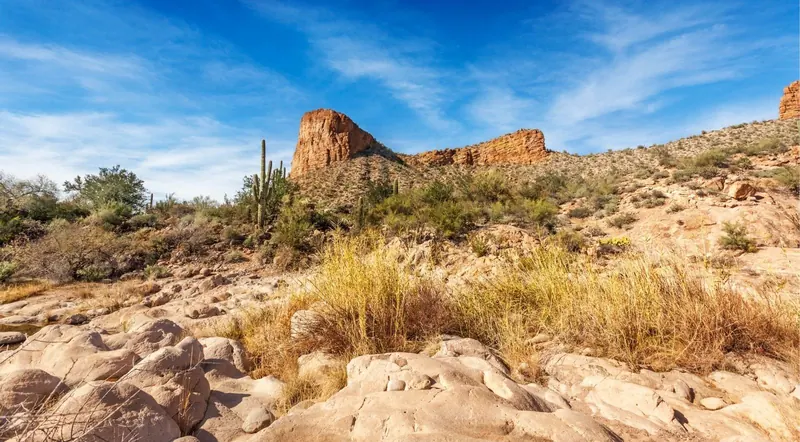
The Apache Trail is known for its hairpin turns, canyons and cactus-covered mountain views. Slow down and look away from the road, and you start to notice the animals: a roadrunner slipping between creosote bushes, a red-tailed hawk circling on the thermals, and now and then a desert bighorn sheep standing still on a rock ledge.
Winter is a good time to look for wildlife around the Apache Trail and the Superstition Mountains. Cooler days make walking and waiting more pleasant, and the first and last hours of daylight are usually the best viewing windows. For an easy desert wildlife walk, go to Usery Mountain Regional Park. For mountain habitat and birds, go to Lost Dutchman State Park. For a narrated boat trip, take a Saguaro Lake cruise, and for the free-roaming horses, plan a separate morning on the Lower Salt River. Desert bighorn sheep live in the Canyon Lake area, but sightings are never guaranteed, and Canyon Lake is closed to public access during its 2026–27 drawdown. (Arizona Game & Fish: wildlife-viewing tips; SRP: Canyon Lake drawdown)
If you have only a few hours, don’t spend them driving after an animal that may not show. Choose a landscape you’ll enjoy without a sighting, bring binoculars and stay still longer than feels necessary. That’s usually the difference between a pleasant scenic outing and a memorable encounter.
Winter 2026–27: Canyon Lake, including its boat ramps and public access points, has been closed since September 8, 2026 for a drawdown project, and the Dolly Steamboat is suspended (details in our Dolly Steamboat closure guide). SRP’s schedule is approximate and gives no firm reopening date. Don’t book a Canyon Lake cruise or walk onto the exposed lakebed unless official notices confirm it has reopened. SR-88 itself stays open; see is the Apache Trail open for road status.
No car? The calendar above is for Phoenix/Scottsdale: Apache Trail Tour & Canyon Lake Cruise, a guided day with hotel pickup across the Phoenix area, rated 4.9/5 from more than 25 reviews on GetYourGuide. Despite the title, this winter’s itinerary takes its 80-minute narrated cruise on Saguaro Lake, outside the Canyon Lake closure, and the cruise ticket is bought separately. It is a sightseeing day through the Superstition Mountains and Goldfield Ghost Town and isn’t a wildlife tour, so any eagle or sheep you see from the boat is a bonus.
Is the Apache Trail good for wildlife watching?
Yes, if you treat it as a scenic desert outing with wildlife in it, and don’t expect a safari. The appeal is the mix of habitats: rocky cliffs that suit bighorn sheep, saguaro foothills and washes where smaller animals find cover, and reservoir and river corridors that draw waterbirds, raptors and mammals. No responsible guide can promise you a wild animal.
A good day might mean hearing Gambel’s quail calling in the brush, picking out a handful of hawks and watching a lizard sun itself on a rock. A bighorn sheep or an eagle is the rare extra. A bobcat is luck.
Arizona Game & Fish advises visitors to work the edges between habitats, move quietly, pause often and use binoculars; many species are most active near the beginning and end of daylight. (Wildlife-viewing tips)
What to watch for, and where
| Wildlife | Best habitat to scan | Realistic expectation | Good first choice |
|---|---|---|---|
| Gambel’s quail and smaller desert birds | Scrub, washes, park trails | Easier to notice by sound and movement than large mammals | Usery Mountain or Lost Dutchman |
| Roadrunners | Open ground beside brush and trails | Possible, never on a schedule | Desert park edges |
| Red-tailed hawks and other raptors | Cliffs, poles, open sky | Good birdwatching targets; identifying species takes practice | Scenic overlooks or park trails |
| Desert bighorn sheep | Steep rocky slopes and canyon ledges | A special sighting; bring patience and binoculars | Canyon Lake-area cliffs from legal, open spots |
| Bald eagles | Lakes, rivers and reservoir shorelines | Possible, far from guaranteed | Public viewpoints around Saguaro Lake or the Salt River |
| Coyotes and javelinas | Scrub and wash corridors | Sometimes encountered; don’t approach | A quiet early-morning park visit |
| Bobcats | Rocky desert cover | Rare and elusive | No reliable public viewing spot |
| Salt River free-roaming horses | Lower Salt River banks | A separate outing, still not guaranteed | Coon Bluff, Blue Point or the Goldfield recreation site on the river |
These are habitat suggestions, and no species is certain to turn up at every stop listed. Be wary of any tour page that promises a particular animal.
Other trips near the Apache Trail this winter
A wildlife morning leaves time for more: Goldfield Ghost Town, cruises on Saguaro Lake, Jeep and UTV rides in Bulldog Canyon and the Tonto National Forest, and longer day trips to Sedona and the Grand Canyon.
1. Desert bighorn sheep: the Apache Trail’s signature sighting
Spotting a bighorn sheep on an Arizona canyon wall is disorienting. Its sandy coat blends into the rock, and the animal looks far too big for a ledge that narrow. If you find a ram with heavy curling horns, binoculars make the moment much better.
Arizona Game & Fish names Canyon Lake as an important place for desert bighorn sheep and has run biologist-led bighorn viewing events there in June. That makes the area good sheep habitat. It does not mean a winter visitor will see sheep, or that those events run from November to February. (AZGFD bighorn viewing events) Our Canyon Lake visitor guide covers the lake in a normal year.
Where to look
On an open, legal outing, scan rocky shelves, steep slopes, shaded recesses and ridgelines as well as the water. Use binoculars from a safe, established overlook. Sheep may be far above the road and very hard to tell apart from the stone.
Don’t scramble onto loose shoulders, enter closed shoreline areas or stop on a narrow bend for a better angle. A sighting isn’t worth a traffic hazard or a disturbed animal.
Can you see bighorn sheep on the Dolly Steamboat?
In a normal season, Canyon Lake cruises pass bighorn habitat, though they aren’t wildlife tours. During the 2026–27 drawdown, Canyon Lake’s public access points are closed and the Dolly Steamboat is suspended. Check any reopening directly with the operator and SRP before you plan around it.
Can you see them at Saguaro Lake instead?
Possibly. The Desert Belle lists desert bighorn sheep among the animals that live around Saguaro Lake, along with bald eagles, wild horses, deer and bobcats, but that doesn’t make each departure a sheep-spotting trip. Treat it as a scenic, narrated nature cruise with a chance of sightings. (Desert Belle narrated cruise)
2. Bald eagles and other birds of prey: winter’s best birdwatching
A bald eagle over a reservoir looks nothing like the one on the national emblem: a broad-winged shape crossing the water, then maybe settling in a distant tree. The Salt River reservoirs support bald eagles, but finding a nest is not an invitation to approach it.
Arizona’s bald eagles breed in the cooler part of the year. Each season, land managers close public land and water near breeding areas; in recent years the closures have started around early December and run into June, and the 2026–27 list was not yet posted when we checked in November 2026. Arizona Game & Fish asks visitors to watch from outside posted closures, use telephoto lenses or binoculars and back away if an eagle becomes agitated. Drones near nests are a particular problem. (AZGFD eagle etiquette; last season’s closure notice, December 2025)
What to look for: broad soaring silhouettes over open water, perched birds in big lakeside trees, and large raptors riding the air along cliff edges. Not every large dark raptor is an eagle: red-tailed hawks and other birds of prey live here too.
How to watch: pick a public lake or river viewpoint, sit quietly and scan with binoculars. Don’t share the location of an active nest, follow an eagle into a closed area or flush a nesting bird for a photo.
Other birds you might notice in desert habitat include Gambel’s quail, cactus wrens, curve-billed thrashers, roadrunners, ravens and several hawks. Species vary by habitat and season; for serious birding, a local checklist or recent sightings log is more useful than a generic “must-see” list.
3. Coyotes, javelinas, bobcats and the smaller life of the desert
The Apache Trail’s rock walls pull your eyes upward, but most casual encounters start lower down, where a wash meets a thicket or a bush moves unexpectedly.
Javelinas are stocky, pig-like peccaries (not wild pigs), usually seen in small groups. Give them plenty of room, especially with young around, and never feed them or stand between them and an escape route. Coyotes may cross the road or trot through the brush; don’t approach or feed them. Bobcats live in the desert but are secretive, and planning a trip around one usually ends in disappointment.
Small encounters count too. A Gambel’s quail calling, a bird darting across the trail or a raptor circling over a wash are more realistic goals for a short outing.
For families: give children a “spot the habitat” challenge instead of promising a bobcat or a sheep. Look for a hole in a saguaro, a wash where tracks might show, a high perch for raptors and flowering or fruiting plants that attract birds. Look at signs of wildlife without handling scat or disturbing burrows.
The five best places to look for wildlife near the Apache Trail
These places are not all on SR-88. They sit in the wider Mesa, Apache Junction and Superstition Mountains area, and some work better as separate trips.
1. Usery Mountain Regional Park: the easiest winter wildlife walk
Best for: first-time visitors, families, birdwatchers, easy walking and anyone who wants a ranger-led introduction.
Location: 3939 N. Usery Pass Road, Mesa, Arizona.
Usery Mountain is a sensible first stop because you can watch for animals without any rough driving. Its nature center and trails sit in Sonoran Desert habitat on the eastern edge of the Phoenix area. From November 1 to April 30 the park is open 6 a.m. to 8 p.m. daily and the nature center 8 a.m. to 4 p.m. daily. (Maricopa County Parks: Usery Mountain)
The barrier-free Merkle Trail suits a gentle wildlife outing. On Thursday, December 3, 2026, rangers lead a “Creatures of the Morning” hike there, 8 to 9 a.m. on the roughly one-mile route, limited to 20 people. Register ahead, and look for similar programs on the park calendar if your dates differ. (Maricopa County Parks event listing)
Allow: 60–120 minutes. Start early and spend more time watching than walking.
Downside: it isn’t the narrow-canyon Apache Trail scenery, and you may still see only birds and small animals. Many visitors will find that an easy trade.
2. Lost Dutchman State Park: the mountain backdrop
Best for: classic Superstition Mountain scenery with gentle nature watching.
At the foot of the Superstition Mountains, Lost Dutchman State Park lets you watch for animals on foot instead of from a moving car. Look and listen along the maintained trails and day-use areas, and pick a walk that suits everyone in your group. Early morning usually gives the best mix of light and quiet. The park also runs ranger-guided “Wildlife of the Sonoran Desert” hikes this winter, on December 4 and December 18, 2026; our Lost Dutchman State Park winter guide has the details, fees and trail hours.
The cliffs are spectacular, but don’t treat the hardest mountain routes as casual wildlife walks. The Flatiron and the steep upper sections of Siphon Draw are no substitute for an easy family outing.
Allow: 60–150 minutes depending on the trail. Check Arizona State Parks for current access, trail conditions and entry fees.
Downside: popular trailheads can be busy on winter weekends. Go early and keep your hopes for large mammals modest.
3. Saguaro Lake: an easy guided nature trip on the water
Best for: visitors who don’t want to hike, anyone hoping to combine desert scenery with a chance of birds and cliff wildlife, and families who want a narrated trip.
The Desert Belle runs an 80-minute narrated cruise covering the lake’s geology, geography and wildlife. The boat has an open upper deck and an enclosed, climate-controlled lower cabin that the operator describes as handicap accessible, plus two bathrooms. It’s a comfortable way to see the landscape without a hard trail, but confirm any specific boarding needs before you book. Our Desert Belle cruise guide compares the narrated and live-music cruises and the seats.
Narrated-cruise tickets cost $33.95 for adults aged 13–64, $31.95 for seniors 65 and over, and $21.95 for children 12 and under, and prices can change. A Desert Belle ticket doesn’t include transport from Phoenix or Scottsdale; the guided day tour above does, with the cruise ticket bought separately. To weigh the Desert Belle against the Dolly Steamboat for wildlife and scenery, see our Saguaro Lake vs Canyon Lake guide.
What you might see: eagles or other raptors, cliff-dwelling mammals and waterbirds. What you will see, weather permitting, is the contrast of deep desert and blue water.
Allow: about 2–3 hours at the marina for parking, check-in, boarding and the cruise, plus your travel time.
Downside: a narrated sightseeing cruise is not a specialist wildlife trip, and large mammals and eagles can be absent on any sailing.
4. Canyon Lake corridor: the best-known sheep habitat, closed this winter
Best for: a future Apache Trail sightseeing drive, once the lake reopens, for visitors who enjoy the habitat even without a sighting.
The road from Apache Junction toward Tortilla Flat and Canyon Lake passes striking rock formations, but the lake itself is closed to public access during the 2026–27 drawdown. Don’t walk onto the exposed lakebed or into closed recreation sites for photos. SRP warns that newly exposed shoreline can hide deep mud, unstable ground and drop-offs. (SRP drawdown information)
Stick to the open road and legal pullouts. The Apache Trail is still worth driving for its geology and views, but its Fish Creek Hill section is not suitable for standard passenger cars: Arizona DOT limits the stretch from milepost 222 to 223.5 to high-clearance 4WD vehicles and UTVs, with no trailers, inside a primitive dirt section from MP 220 to 229.2. (ADOT SR-88 status) Our Fish Creek Hill rental car guide explains what your rental agreement allows.
Allow: 2–4 hours for an out-and-back scenic drive with stops, depending on your starting point and the road.
Downside: don’t build a winter plan around a closed lake, or expect to see sheep from the road.
5. Lower Salt River and Coon Bluff: a separate trip for the free-roaming horses
Best for: travelers whose top wildlife goal is the free-roaming horses more than the Apache Trail itself.
The Salt River horses are one of the Phoenix area’s most distinctive sights, but they are in a different place: the Lower Salt River corridor along the Bush Highway. It is no roadside stop on the drive to Tortilla Flat. Coon Bluff is the most often recommended viewing area, and Blue Point and the Goldfield recreation site upriver are quieter alternatives. The horses roam freely, so no spot guarantees a sighting.
Watch the names: the Goldfield recreation site on the Salt River is not Goldfield Ghost Town on the Apache Trail. The similar names cause confused directions, so check your navigation destination carefully. (The ghost town has its own Goldfield Ghost Town winter guide.)
Parking at Coon Bluff needs a Tonto Pass ($8 per vehicle per day) or an America the Beautiful pass, displayed in the car; you can buy a Tonto Pass online or at nearby stores. Stay at least 50 feet from the horses at all times, and never feed, touch or chase them. (Visit Mesa: Coon Bluff)
Allow: 90 minutes to 3 hours including time waiting quietly, more if you’re coming from central Phoenix.
Downside: it’s easy to spend a morning waiting for a herd that is somewhere else. Enjoy the river even when the horses don’t appear.
Best time to see wildlife on the Apache Trail
Early morning is the strongest default. Arizona Game & Fish says many animals are most active around the first and last hours of daylight, though each species has its own pattern. Winter’s milder temperatures make the middle of the day comfortable for you, but that doesn’t mean every mammal is active at noon. (Wildlife-viewing tips)
| Time | Why go then | Trade-off |
|---|---|---|
| Sunrise to about 2 hours after | Quieter trails, softer light, active birds and some mammals | Cold mornings; some parks and access areas open at set times |
| Late morning to early afternoon | Comfortable sightseeing; easy to combine with a museum or a boat cruise | Less likely for some mammals; harsher light for photos |
| Last 2 hours before sunset | Warm low light, birds and possible wildlife | Winter daylight ends early; don’t get caught on remote roads after dark |
| After dark | Some species are nocturnal | Not for casual roadside searches or unprepared walking; obey park closing hours |
November, December, January and February
- November: pleasant daytime temperatures suit long watching sessions, though some afternoons are still warm. A good month to combine wildlife with sightseeing.
- December: short days reward early starts. Bald eagle breeding-area closures usually begin around now; read every posted sign.
- January: usually comfortable all day outdoors. Wear layers at dawn and check the weather before driving remote sections.
- February: still a good month; early blooms can bring more bird activity after a wet winter, but bloom timing varies a lot with rainfall (see our Apache Trail wildflowers guide). Eagle nesting closures still apply.
These are tendencies and promise nothing about animals or the weather on your dates.
Wildlife tour, boat cruise or self-drive?
| Option | Why choose it | What it can’t promise | Before you book |
|---|---|---|---|
| Desert Belle narrated cruise | Easy access to lake scenery and narration without hiking | A particular eagle, sheep, bobcat or horse | Book it for the boat trip first, wildlife second |
| Guided Apache Trail day trip | No driving or navigating; a local guide explains the desert | Specialist wildlife tracking; routes vary | Ask for the actual stops, total length, pickup and which lake the cruise uses |
| Ranger-led nature walk | Interpretation, and help identifying plants and birds | Large mammal sightings | Check the park calendar, registration, fitness level and cancellation rules |
| Self-drive plus a short park walk | Full flexibility and time to watch patiently | A guide’s knowledge, or any certainty of finding animals | Best if you have a car and binoculars |
| Specialist photography or birding guide | Local natural-history knowledge and proper optics | Guaranteed rare encounters | Ask whether it is truly wildlife-focused and whether it runs in winter |
Our pick for most first-time visitors: a self-drive morning at Usery Mountain or Lost Dutchman, plus a separate Apache Trail scenic drive. Choose the Desert Belle if you’d like a comfortable trip on the water, or the guided day tour at the top of this page if you’d rather not drive at all. If the horses matter most, go to the Lower Salt River instead of squeezing every place into one rushed day. Our Apache Trail tour from Phoenix guide compares the guided options.
Questions to ask before booking a guided trip
- Is this a wildlife-focused tour, or a sightseeing trip that sometimes sees animals?
- Which lake, park or river area does it visit?
- How much time is spent watching quietly, and how much driving?
- Does the price include park entry, the boat ticket and transport?
- Is the tour running during the Canyon Lake closure, and which lake does it use instead?
- Does the vehicle have high steps or a difficult transfer for travelers with limited mobility?
- Will the guide follow seasonal eagle closures and keep a respectful distance from wildlife?
- What happens if no animals appear, or if rain cancels the trip?
A company that promises a guaranteed wild bighorn or eagle sighting deserves questions before you pay.
Three winter wildlife itineraries
Itinerary A: an easy morning, 2–3 hours from Mesa or Apache Junction
7:30–9 a.m. (adjust to sunrise and park opening): walk an easy trail at Usery Mountain Regional Park. Stop often, scan the scrub with binoculars and listen for birds. 9–10 a.m.: visit the nature center, which opens at 8 a.m. in winter, or keep watching from the trail. Leave the rest of the morning for coffee or a stop in Apache Junction.
Choose this if: you’re traveling with children or older relatives, don’t want rough roads, or would rather notice several species than tick off famous sights.
Skip: long hikes, and chasing reported sightings across several remote stops.
Itinerary B: scenery with a chance of wildlife, 5–7 hours
Morning: spend 60–90 minutes at Lost Dutchman State Park, keeping the walk easy and watching the foothills. Late morning: stop at Goldfield Ghost Town if history appeals. Midday: continue on the paved Apache Trail toward Tortilla Flat, stopping only at legal pullouts for views and birds. Afternoon: return to the East Valley instead of attempting the restricted Fish Creek Hill section in an ordinary rental car.
Choose this if: you want the Apache Trail’s landscape, with wildlife as a welcome extra. It’s the most balanced choice for first-time visitors to the Superstitions.
Skip: closed Canyon Lake shoreline areas, and any unpaved section your rental agreement or car can’t handle.
Itinerary C: a day on the water, 4–6 hours
Morning: take a Desert Belle narrated cruise on Saguaro Lake. Arrive early enough to check in and find a good viewing spot. After the cruise: have a relaxed lunch and, if time and access allow, spend a quiet hour at a Lower Salt River recreation site.
Choose this if: you want water scenery, a comfortable narrated trip, or a day that suits companions who can’t walk far. A standard Desert Belle ticket doesn’t include transport from the city.
Alternative: if the wild horses are your real goal, skip the cruise and spend the morning at Coon Bluff. They are separate trips, and a longer itinerary won’t necessarily bring better sightings.
How to watch and photograph desert animals responsibly
Bring: binoculars (an 8×42 pair is a good all-round choice), water, closed-toe shoes, sun protection, a warm layer for dawn, a charged phone, and a camera with a longer lens if photos matter to you. A small notebook or an offline bird guide turns quick sightings into a record you’ll keep.
Do:
- Stand or sit still and wait; movement draws animals’ attention.
- Watch birds and mammals from a distance, using optics instead of walking closer.
- Keep clear of animals’ paths to water, feeding areas and young.
- Stay on open trails and at legal roadside pullouts.
- Follow every posted restriction, especially at eagle nesting areas.
- Photograph natural behavior, and never push an animal into moving for the camera.
Don’t:
- Feed or bait wildlife for photos.
- Play bird calls over and over, or fly drones near nests.
- Follow or corner javelinas, sheep, horses or predators.
- Stop a car on a blind curve or stand in the road with a camera.
- Cross a closure line to reach a shoreline, nest or ledge.
Arizona Game & Fish’s core advice is simple: let animals behave naturally, and don’t block their access to water, shelter or young. (AZGFD wildlife-viewing tips)
Wildlife safety in practice
If you meet a rattlesnake, give it plenty of room and let it move away; never try to handle or move it. Keep small children close, and watch where you put your hands and feet near rocks and brush. Never approach an injured wild animal. If a large animal blocks the path, back off and take another route. Keep dogs under control and follow park rules, because a loose dog can cause a dangerous encounter for wildlife and people alike.
For road conditions, use AZ511 and ADOT’s Apache Trail page, especially after heavy rain or rockfall.
Is Apache Trail wildlife watching worth paying for?
Usually you pay for the narration or the trip itself, with no animal promised. A narrated Saguaro Lake cruise is good value if you want to float between saguaro-covered hills, hear about the Sonoran Desert and enjoy a boat ride. A ranger walk is more useful if you mainly want to identify birds, tracks and plants. A private wildlife guide can make sense for committed photographers, once you’ve checked their background and actual routes.
For most first-time visitors, an early morning in a well-run public park with a pair of binoculars is a fine start. You’ll often see more by sitting quietly for 20 minutes than by rushing between five “wildlife hotspots.”
Frequently asked questions
What animals can you see on the Apache Trail?
Desert birds such as quail, roadrunners and raptors, plus coyotes, javelinas, desert bighorn sheep and rarer mammals. Sightings depend on place, time, weather and luck. Don’t expect every species on one drive.
Where is the best place to see desert bighorn sheep near the Apache Trail?
The Canyon Lake area has well-documented bighorn habitat, but public lake access is closed during the 2026–27 drawdown. Use legal, open viewpoints only, bring binoculars and never count on a sighting. (AZGFD bighorn viewing events)
Can I see bighorn sheep from a boat?
Possibly, on a cruise that is running on open lake habitat. The Desert Belle lists bighorn sheep among Saguaro Lake’s wildlife, but sightings aren’t guaranteed. Canyon Lake is closed during the 2026–27 drawdown.
Are bald eagles present around Saguaro Lake?
Bald eagles live on Arizona’s lake and river systems, and the Desert Belle lists them among Saguaro Lake’s wildlife. Any single sighting is unpredictable. Follow eagle nesting closures and watch from a distance. (Desert Belle; AZGFD)
Is winter better than summer for wildlife watching?
Winter is more comfortable for walking, waiting and traveling in the low desert. Some birds are present only in certain seasons, and raptor watching can be good. Animal movement varies by species, though, and winter doesn’t guarantee more mammals than other seasons.
What is the best time of day to see wildlife?
Early morning and late afternoon suit many species, though not all wildlife follows that pattern. Stay within park and recreation-area opening hours. (AZGFD viewing advice)
Can I see the Salt River wild horses on the Apache Trail?
The horses live along the Lower Salt River by the Bush Highway, away from the SR-88 drive to Tortilla Flat. Plan them as a separate trip, starting at Coon Bluff or another recreation site on the river. The horses move freely and can’t be guaranteed.
Is Goldfield Ghost Town the same as the Goldfield recreation site?
No. Goldfield Ghost Town is a historic-themed attraction near Apache Junction on the Apache Trail. The Goldfield recreation site is a Lower Salt River access point some horse watchers use. Double-check the name in your navigation app before you set off.
Are the Salt River horses dangerous?
They are free-roaming, powerful animals and can react unpredictably. Stay at least 50 feet away, never feed or touch them, and leave their path to the water clear. (Visit Mesa: Coon Bluff)
Is Saguaro Lake or Canyon Lake better for wildlife in winter 2026–27?
Canyon Lake is known for bighorn habitat, but public access is closed during the drawdown. Saguaro Lake’s Desert Belle cruise is the boat trip that is running, subject to its schedule and the weather. Neither guarantees sightings.
Do I need a Jeep to look for wildlife?
Not for park trails, the paved road to Tortilla Flat or Saguaro Lake. The Apache Trail’s Fish Creek Hill section, milepost 222 to 223.5, is limited to high-clearance 4WD vehicles and UTVs, so don’t try it in an ordinary rental car. (ADOT)
Are wildlife cruises suitable for older travelers and children?
The Desert Belle has an enclosed, climate-controlled lower cabin the operator describes as handicap accessible, two bathrooms and family-friendly narrated cruises; all children under 13 must wear a life jacket, which the boat provides. Confirm boarding arrangements for specific mobility needs and current departure times before paying. (Desert Belle)
Are there free places to see wildlife?
Some public areas charge no tour fee, but county and state park entry fees and National Forest passes such as the Tonto Pass often apply. Check each site instead of assuming roadside parking or river access is free.
Can I see wildlife without hiking?
Yes. Legal scenic overlooks, developed park areas and the Desert Belle cruise let you watch with little walking. Patience and binoculars matter more than distance. For wheelchair access, confirm surfaces, parking, boarding and restrooms one by one.
Will a guide guarantee a bighorn sheep or eagle?
No ethical wildlife operator promises a sighting of a free-ranging animal. Ask which habitats the trip visits and what the guide knows, and book only if the trip would still be worth it without a rare encounter.
Can I fly a drone near bald eagles?
Keep drones away from eagle nesting habitat. Arizona Game & Fish has documented serious nest disturbances from drones and asks pilots to respect seasonal closures and stay well clear of breeding areas. (AZGFD eagle etiquette)
What should I do if I see a bobcat or coyote?
Watch from a safe distance, never feed or follow it, and leave it a way out. No photo is a reason to change its behavior.
Can I visit Canyon Lake during the drawdown to look for animals?
Don’t enter closed lake recreation areas, the exposed lakebed or the shoreline. SRP warns of unstable mud and sudden drop-offs. SR-88 stays open, but that doesn’t override the lake closures. (SRP)
Choosing your winter wildlife day
The best Apache Trail wildlife day is one you’ll enjoy even if the animals stay hidden. For a gentle morning of birds and desert ecology, go to Usery Mountain. For dramatic geology and a chance of wildlife on a short walk, go to Lost Dutchman. For an easy guided trip, take a Saguaro Lake cruise. If your heart is set on the free-roaming horses, give the Lower Salt River its own morning instead of tacking it onto a crowded Apache Trail day.
The Sonoran Desert isn’t empty; it’s easy to miss when you move too fast. For the rest of the season, see our Apache Trail in winter guide and the Sonoran Desert and Superstition Mountain tours guide.
Affiliate disclosure: we earn a commission if you book through our GetYourGuide links, at no extra cost to you. The parks, trails and river sites on this page are not tours, and we don’t earn anything from them.
Planning a winter trip? Check your exact date on the featured Apache Trail day tour or see our best Apache Trail tours comparison, because winter weekends fill early and lake access can still change.
The Superstitions, Goldfield and a Lake Cruise in One Day
Hotel pickup, a local guide and a group of five or fewer, with Goldfield Ghost Town and an 80-minute cruise on Saguaro Lake. The cruise ticket, about $34, is bought separately after booking, and at least two adults must book. Free cancellation up to 24 hours before.
Check Availability & Book