Arizona Wildflowers Near the Apache Trail: Where to See Spring Blooms in 2027
Where to see spring wildflowers near the Apache Trail and the Superstition Mountains in 2027: Lost Dutchman, Usery Mountain, Silly Mountain and Peralta, bloom timing, easy walks and what to check before you go.
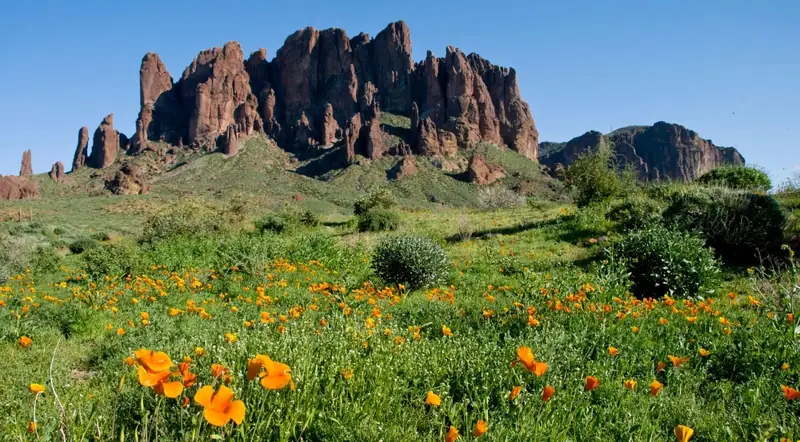
On an ordinary winter day the foothills of the Superstition Mountains look almost monochrome from a distance: ochre rock, grey-green shrubs and the upright outlines of saguaros. After a wet winter and a warm spring, the hillsides change. Yellow poppies spread beneath the volcanic cliffs, purple lupine lines the trail edges, and brittlebush turns whole slopes yellow.
It is one of the most photogenic sights in the Sonoran Desert, and one of the easiest to misjudge. No calendar date guarantees a carpet of flowers, the most famous trail is not always the best one for a family, and many photos posted online are from earlier springs.
For spring wildflowers near the Apache Trail, start at Lost Dutchman State Park for the mountain backdrop, go to Usery Mountain Regional Park for the easiest walking, and add Silly Mountain Park as a short stop near Apache Junction. Small blooms can appear from late February, but March is usually the better month to plan around, with some flowering into April depending on weather, elevation and species. Nobody can reliably predict the 2027 bloom as of November 2026.
Planning for 2027? Book a spring trip to see the desert as a whole, and treat a superbloom as a bonus. Check local bloom reports shortly before you go, pick a backup activity, and stay on marked trails even when flowers sit just out of reach.
No car? The calendar above is for Phoenix/Scottsdale: Apache Trail Tour & Canyon Lake Cruise, a guided day with hotel pickup across the Phoenix area: about 9 hours, from $215 per person, rated 4.9/5 from more than 25 reviews on GetYourGuide. It is a general sightseeing day through the Superstition Mountains with a cruise on Saguaro Lake this winter, not a wildflower tour, so treat any blooms you pass as a bonus.
At a glance: the best wildflower spots near the Apache Trail
| Place | Best for | Walking | Landscape | Trade-off |
|---|---|---|---|---|
| Lost Dutchman State Park | The classic poppies-and-Superstitions photo | From a short paved nature path to a moderate hike | Sheer mountain walls and open foothills | Entry fee; busy at the spring peak; longer trails are rocky |
| Usery Mountain Regional Park | Families, mixed mobility, first desert visit | Merkle Trail about 0.9 mile round trip, barrier-free | Saguaros, wide desert views, flowering slopes in good years | Not on SR-88; entry fee |
| Silly Mountain Park | A short, handy stop and plant identification | Botanical Walk about 0.3 mile | Low hills, native-plant signs and valley views | Small site; blooms vary; closes at sunset |
| Peralta Regional Park / Gold Canyon area | Quieter foothills and varied desert walks | Short interpretive walks and a longer trail network | Southern Superstition foothills | Off the Apache Trail; check trail and access details |
| Apache Trail scenic drive (SR-88) | Desert scenery with very little walking | Viewing from roadside and designated stops | Saguaros, cliffs, seasonal patches of color | Not every shoulder is safe or legal; Canyon Lake areas closed |
Our pick for most visitors: start with Lost Dutchman. If easy terrain matters more to you than the classic photo, walk Usery’s Merkle Trail. If you’re already driving to Goldfield or Tortilla Flat, add Silly Mountain only if it fits your route; it isn’t worth a long detour for a bloom nobody has reported.
Other things to do near the Apache Trail in spring
A wildflower morning leaves time for more: Goldfield Ghost Town and its mine tour, cruises and kayak trips on Saguaro Lake, off-road rides in Bulldog Canyon and the Tonto National Forest, and longer day trips to Sedona and the Grand Canyon.
When do Apache Trail wildflowers bloom?
February: early flowers can appear at lower elevations after good winter rain, especially in mild spells. Treat February as a chance of early color; mass flowering is a less safe bet. Visit Mesa notes that the season around Mesa can start in February. Our Apache Trail in winter guide covers what else is open then.
March: the best month to aim for. Visit Mesa describes mid-March as a typical peak around Mesa, and Visit Phoenix places the wider desert wildflower season mainly in March and April. That is a regional pattern and no guide to an event date.
April: later flowers and higher pockets still bloom, but low-elevation poppy displays can fade quickly as temperatures climb. Different plants flower at different times. Saguaro blossoms come later still, usually from late April into June, peaking in May.
| Travel period | How to plan | What not to assume |
|---|---|---|
| Early February | Enjoy the desert, check early sightings, plan other stops | That fields of poppies are already out |
| Late February | Good for watching the season start | That every hillside is flowering at once |
| Early to mid-March | Often the strongest bet, especially after winter rain | That a superbloom has been confirmed |
| Late March | Good potential, but more weather-dependent each week | That an earlier peak is still at its best |
| April | Look for later-flowering species; change location | That yellow poppy carpets continue everywhere |
What makes a good bloom year?
The amount of winter rain, when it falls, soil moisture, temperature and how fast things dry out all matter. Good rain helps seeds germinate; hot, dry weather can cut a display short. A wet winter does not guarantee that a particular hillside will bloom, and a dry one does not mean there will be nothing to see. Parts of central Arizona were in moderate drought in mid-2026, which tells you nothing reliable about spring 2027. Local sightings beat statewide predictions.
Can anyone predict a 2027 superbloom yet? Not responsibly in November 2026. Treat any headline announcing a superbloom months ahead as speculation, and look for dated, location-specific photos and reports in February and March 2027 instead. Our best time to visit the Apache Trail puts spring in the context of the whole year.
1. Lost Dutchman State Park: the best mountain backdrop
Location: 6109 N Apache Trail, Apache Junction, AZ 85119 Best for: first-time visitors, photographers, moderate walkers and anyone who wants the classic Superstition Mountains view Allow: about 45 minutes for a short stop; 1½ to 3 hours for a longer walk
This is the photo most visitors have in mind: a jagged wall of rock rising straight out of the desert. In a strong spring, patches of yellow cover the open lower slopes. Even in a poor year the setting is remarkable, which is why Lost Dutchman is the safest choice if you have only one morning. Our Lost Dutchman State Park guide covers the trails, campground and fees in detail.
Which trail should you take?
- Native Plant Trail: the easiest introduction, a short paved nature path near the visitor area, about 0.2 to 0.25 mile on the park’s trail map. Good for learning what you’re looking at without committing to a hike.
- Treasure Loop Trail: the classic moderate walk, 2.4 miles round trip with about 500 feet of elevation change. The wide views make it popular with photographers. It is not a flat stroll, so wear proper shoes and bring water.
- Siphon Draw / Flatiron: a different undertaking altogether. The upper route is steep, rocky and demanding. Don’t choose it just to find flowers; the lower foothills suit a relaxed wildflower morning better.
Is it a good visit in a weak bloom year? Yes. The mountains, saguaros and short nature paths still make a fine desert morning. Should you pay the entry fee only for a guaranteed blanket of poppies? No: check recent reports first.
Practical advice: arrive early on spring weekends, ask park staff what is flowering and how the trails are, and check the park’s official site for fees, events and alerts before you leave.
2. Usery Mountain Regional Park: the easiest wildflower walk
Location: 3939 N Usery Pass Road, Mesa, AZ 85207 Best for: families, seniors, relaxed photographers and anyone who wants easier footing Allow: 60 to 120 minutes for a short visit; longer for other trails
Usery lacks Lost Dutchman’s famous mountain wall, but it has a fine mix of cacti, open slopes and easy trails. In good years, poppies and other flowers brighten the foothills. Visit Mesa recommends the park for spring wildflowers, and Maricopa County’s own guide highlights its accessible routes.
Take the Merkle Trail
The Merkle Trail is about 0.9 mile round trip and classed as barrier-free by Maricopa County Parks. It is a much better choice than a rocky slope if you want flowers without a scramble. The county describes it as suitable for wheelchairs and strollers; still, check the gravel surface and current conditions against your own needs.
For a longer easy walk, try a short out-and-back on the Blevins Trail; you don’t have to do the whole 3 miles. Wind Cave is much harder and not the obvious choice for young children or someone who came mainly to photograph flowers.
Fees and hours: Maricopa County lists a standard regional-park day-use fee of $10 per vehicle, scheduled to stay the same in 2027. Usery’s winter hours are 6 a.m. to 8 p.m. from November through April; confirm before you go.
Choose Usery if you want a good morning even when the poppies are scattered. It is a pleasant place to learn the desert’s plants as well as to chase a photo.
3. Silly Mountain Park: a quick botanical stop
Location: northeast of the intersection of US-60 and Silly Mountain Road, Apache Junction Best for: short outings, families and curious beginners Allow: 20 to 60 minutes for the botanical walk; longer for the hillside trails
Despite its name, Silly Mountain has a gentle native-plant route. The Botanical Walk is about a third of a mile on compacted crushed granite, with signs identifying desert plants. The Superstition Area Land Trust, which looks after it, describes it as wheelchair accessible.
Don’t come expecting carpets of flowers. You come to see the variety of Sonoran Desert plants up close, which matters in a weak year: individual blossoms, flowering shrubs and small plants along a marked path can give you plenty to look at.
Steeper hillside trails lead to the viewpoints; check the city’s Silly Mountain trail map before choosing one. The park is open from sunrise to sunset, so don’t plan to walk back after dark.
Choose Silly Mountain for a short, easy stop when your day is already based around Apache Junction or Goldfield Ghost Town.
4. Peralta and the Gold Canyon foothills: an extra desert walk
Peralta is on the southern side of the Superstition Mountains, off the usual Apache Trail drive. It shows you another side of the range: open foothills, rugged outlines and quieter desert trails away from Goldfield’s Old West attractions.
Peralta Regional Park has interpretive displays, picnic areas, dry restrooms and more than nine miles of non-motorized trails of varying difficulty. Pinal County notes there is no drinking water, electricity or trash service, so carry what you need and take it all out.
Don’t confuse the regional park with the more demanding Peralta Trailhead into the Superstition Wilderness. The access road to the trailhead is unpaved, and local search-and-rescue guidance warns it can turn slick or damaged after rain. That is a needless risk if you only want a casual flower walk.
Go to Peralta if you’re staying in Gold Canyon or already planning a longer hike. It is an awkward add-on to a full Apache Trail sightseeing day.
5. Apache Trail scenic drive: flowers without a long walk
Route: Apache Junction → Goldfield Ghost Town → SR-88 scenic corridor → Tortilla Flat → return Best for: visitors who want mountain views and a road trip more than a hike
You don’t have to climb a ridge to see spring in the Sonoran Desert. Along the paved part of SR-88, hillsides and roadside washes can show seasonal color. Combine a short flower stop at Lost Dutchman with the drive past Goldfield toward Tortilla Flat, and you’ll see tall saguaros and rocky canyons even if no big bloom appears. Our self-guided Apache Trail drive lists the stops in order.
Important: don’t pull over wherever you see flowers. Narrow shoulders, blind corners, loose ground and traffic make that dangerous. Use established, legal parking areas only, stay out of the roadway when taking photos, and never drive off-road to reach a patch of flowers.
The Fish Creek road warning
You can drive most of the Apache Trail from Apache Junction to Tortilla Flat in an ordinary car. Farther east, ADOT signs restrict the primitive Fish Creek Hill stretch between Fish Creek Vista (milepost 222) and Fish Creek Bridge (about milepost 223.5) to high-clearance four-wheel-drive vehicles and UTVs, with no trailers. ADOT advises checking current conditions, because weather and rockfall can change access. Leave this stretch out of a wildflower drive in a conventional rental car; our Fish Creek Hill rental-car guide shows where to turn around.
Canyon Lake closure: special advice for early 2027
Salt River Project’s 2026 Canyon Lake drawdown closed public access to the lake, boat ramps and shoreline, while SR-88 stays open. The Forest Service closure order runs through February 28, 2027 unless lifted early, and the project schedule is provisional. If you’re visiting between February and April 2027, check whether the lake areas have officially reopened before planning waterside trails, launches or shoreline stops. Never walk on exposed lakebed or enter a closed recreation area. Our Canyon Lake visitor guide has the latest.
A better spring route: Lost Dutchman in the morning, Goldfield Ghost Town for lunch or a short history stop, then the drive to Tortilla Flat. You get one chance at flowers plus two stops that don’t depend on a good bloom year.
Which Arizona wildflowers might you see?
| Flower or flowering plant | What to look for | Practical note |
|---|---|---|
| Mexican gold poppy | Golden-yellow to orange cup-shaped flowers | The star of strong bloom years; flowers open best in sunshine |
| Lupine | Purple-blue flower spikes | Lovely beside poppies, but not guaranteed in any one place |
| Brittlebush | Yellow daisy-like flowers on silvery shrubs | Often stands out on hillsides even without a wide annual bloom |
| Desert marigold | Small golden-yellow daisy-like flowers | Easy to spot as single blooms on a muted landscape |
| Globemallow | Orange, coral or apricot flowers | Adds a different color to poppy photos |
| Chuparosa | Red tubular flowers | Popular with hummingbirds; look above ground level |
| Fairy duster | Delicate pink powder-puff blossoms | Easy to miss unless you slow down |
| Ocotillo | Bright red flowers at the tips of long canes | Often later than the first poppies; timing varies |
Visit Mesa lists these and other Sonoran Desert flowers as spring possibilities around the region. Identification apps help, but cross-check tricky ones against park displays or local experts, and don’t pick or damage plants to identify them.
Are cactus flowers the same as the spring wildflower show?
No, though people often mix them up. Poppies and other early annuals can be at their best in March, while saguaro, prickly pear, cholla and other cacti usually flower later. Saguaro blossoms open from about late April into June, peaking in May, well after most of the classic poppy photos are taken.
Three realistic wildflower itineraries
Itinerary A: Easy 2–3-hour flower morning
Best for: families, slower-paced visitors and anyone staying in Mesa or Apache Junction.
- 8:00–8:30 a.m.: arrive at Usery Mountain Regional Park and ask about the day’s trails and blooms.
- 8:30–9:30 a.m.: walk the Merkle Trail, photographing plants from the path.
- 9:30–10:15 a.m.: visit the nature center or take another short walk.
- Afterward: head back to Mesa for brunch or lunch.
Why it works: little effort, restrooms on site and plenty of desert to look at even without a big bloom. The times are suggestions and don’t follow any park program. Staying in Mesa? Our Apache Trail tours from Mesa guide covers the local Goldfield departures.
Itinerary B: Classic Superstition spring half-day (4–5 hours)
Best for: a first visit and mountain photography.
- 8:00 a.m.: reach Lost Dutchman State Park.
- 8:15–10:15 a.m.: walk part or all of the Treasure Loop, depending on your fitness and the conditions, or use the short paved path.
- 10:30 a.m.: stop at Goldfield Ghost Town for a look around and a drink.
- 11:30 a.m.–12:30 p.m.: drive a short stretch of the Apache Trail or finish with an early lunch.
Why it works: the Superstition backdrop makes the morning worthwhile whatever the flowers do.
Itinerary C: Full spring Apache Trail day (6–8 hours)
Best for: visitors with a car who want wildflowers plus the Old West sights.
- Morning: Lost Dutchman, with a short or moderate walk.
- Late morning: Goldfield Ghost Town; our Goldfield guide lists what is open.
- Lunch: Tortilla Flat, if it’s open.
- Early afternoon: legal scenic stops along SR-88, then back the same way.
- Optional swap: if recent reports favor Usery, trade part of the roadside drive for Usery’s easy trails.
Why it works: you have a good desert day even if the bloom disappoints. Keep off the restricted Fish Creek Hill stretch in a conventional car.
Should you add a lake cruise?
A cruise adds variety, but only if you know where it leaves from and that it is running. The Desert Belle sails on Saguaro Lake, a different lake from Canyon Lake and a separate drive. Our Desert Belle cruise guide covers its tickets, seats and the drive to the marina, and our Saguaro Lake vs Canyon Lake guide compares the two lakes. Don’t assume a cruise comes with an Apache Trail tour. Our Dolly Steamboat closure guide compares the Desert Belle and the other lake options before you build one into your day.
When is the best time of day for wildflower photos?
Morning is the easiest choice: cooler air, more comfortable walking and smaller crowds if you arrive early. Bright sun brings out the yellow in open poppies, while low-angle light gives the Superstition Mountains their texture. The same patch can look completely different backlit or in shadow.
Try two compositions:
- Wide landscape: flowers in the foreground, the Superstition Mountains behind. Shoot from a marked trail or other legal public area, never from inside a flowerbed.
- Small detail: a cluster of flowers with a little desert around it. This often works better than trying to make a modest bloom look like a vast superbloom.
Photo etiquette: no trampling for a better angle, no picking, no drones without checking local rules, and no geotagging fragile off-trail patches that could draw damaging traffic. Keep tripods out of other walkers’ way.
How to find out if the flowers are blooming this week
In the month before your visit, check several sources instead of one viral post:
- Arizona State Parks / Lost Dutchman State Park: park notices, recent photos and visitor-center advice.
- Maricopa County Parks / Usery Mountain: ranger programs, park updates and social channels.
- Visit Mesa and Visit Phoenix: regional wildflower guidance and seasonal updates.
- Dated local photos: look for a date, a real location and signs the picture is from this season.
- Weather and access alerts: AZ511 for SR-88, plus county and park notices for trail closures. Our Apache Trail road conditions guide explains each section of the road.
A photo captioned “Arizona superbloom” may come from another region or another year. For planning, a modest dated photo from Lost Dutchman yesterday tells you more than a spectacular undated shot of poppy-covered hills.
A practical 48-hour decision rule
- Strong bloom confirmed at Lost Dutchman in the last few days: go early and expect crowds.
- Patchy bloom, parks open: pick the site with the best scenery or easiest trail and enjoy the smaller flowers.
- No worthwhile bloom reported: make the day about the desert, Goldfield and Tortilla Flat.
- Rain, washouts, closures or dangerous heat: change your plans. No photo is worth an unsafe trail or road.
Is a guided wildflower tour worth booking?
Sometimes, but not just because a listing says “spring desert.” A standard Apache Trail tour, such as the DETOURS Apache Trail day (from $183, rated 4.6/5 from more than 15 reviews on GetYourGuide), is sold for the drive, the mining history and Goldfield. It may have no flower stops, and no operator can promise blooms.
A guided tour earns its price when you:
- don’t have a car and want hotel pickup;
- want a driver to handle the route and parking;
- want a guide who can explain desert ecology and adjust the route to conditions;
- need a private itinerary matched to your walking ability or interests.
Drive yourself when flowers are the main goal and you’re comfortable driving and walking. You can follow ranger reports, take as long as you like over photos and see Lost Dutchman without paying for a full-day tour. Our tour or self-drive comparison works through the costs.
Before booking, ask these five questions
- Are flower-viewing stops specifically included, or is this a general Apache Trail sightseeing tour?
- Will the guide change location if the blooms are poor at the planned stop?
- How much walking is involved, and on what kind of surface?
- Does the price include park fees, transport and pickup from your hotel?
- What is the cancellation or refund policy if weather or road restrictions change the plan?
Avoid any operator promising a guaranteed February or March superbloom. No guide controls the weather.
How much does a wildflower day cost?
A self-drive wildflower day can be cheap. The big costs are the rental car, fuel and park fees; the flowers themselves are free.
| Item | Planning cost | Notes |
|---|---|---|
| Silly Mountain Botanical Walk | No admission fee | Check city rules and any temporary closures |
| Usery Mountain Regional Park | $10 per vehicle | County’s 2026 fee is scheduled to stay at $10 in 2027 |
| Lost Dutchman State Park | $10 per vehicle with one person, $20 with two to four | Arizona State Parks rates; confirm on the official site |
| Goldfield Ghost Town | Free to walk the street | The train, mine tour and other attractions charge separately |
| Guided sightseeing tour | From about $183 to $215 per person on GetYourGuide | Check the final total as well as the starting price |
| Food, fuel and parking | Varies | Budget extra for a relaxed half or full day |
For a carload of friends, a $10 regional-park fee is excellent value. A full-day private tour makes sense only if it solves a real problem, such as transport, mobility help or a tailored guided day.
What to pack for a February–April wildflower visit
These months are milder than summer, but it is still the desert. Bring drinking water, a hat, sunscreen, sturdy closed-toe shoes and a light layer for cool mornings. Visit Mesa suggests 2 to 3 liters of water per person for a wildflower day; the right amount depends on how long you’re out, the temperature and how hard you walk.
Download a map, because phone signal can be patchy away from developed areas. Leave your plans with someone if you’re walking into more remote country. Watch for loose rocks, spiny plants and wildlife, including rattlesnakes as the weather warms.
For photographers, a zoom or macro lens helps but isn’t necessary. A phone camera and patient framing usually beat hauling heavy gear into a fragile flower field.
Responsible wildflower viewing: the rules that matter
- Stay on designated trails. One shortcut can crush seeds and young desert plants.
- Don’t pick flowers. Each picked bloom means fewer seeds for next year and less for other visitors to see.
- Never drive onto open desert to reach a scenic patch.
- Use established parking. Don’t block SR-88, private driveways, emergency access or trailheads.
- Respect closures, including any Canyon Lake drawdown restrictions still in place on your dates.
- Keep dogs under control where they’re allowed, and follow each park’s rules.
- Leave wildlife alone, even when a snake or lizard would make a great photo.
Leave a wildflower site looking as if nobody had been there.
Frequently asked questions
When will the Apache Trail wildflowers bloom in 2027?
No one can predict an exact 2027 date in November 2026. In a typical year, early flowers appear in late February, stronger displays come in March, and some flowering continues into April. The timing depends on rain and temperature.
What is the best month for wildflowers near Phoenix?
March is usually the best single month for the low desert around Mesa and the Superstitions, but the peak can shift. Plan around recent reports instead of a fixed week.
Where is the best place to see poppies near the Apache Trail?
Lost Dutchman State Park is the first place to try for poppies below the Superstition Mountains in a good year. Usery Mountain Regional Park is a good alternative, especially for easier walking.
Does Lost Dutchman State Park always have wildflowers in spring?
No. The number of flowers varies from year to year, but the scenery is worth the visit even when poppies are sparse.
Are there wildflowers in February?
Possibly, especially at lower elevations after a wet winter. February is less reliable for widespread color than March.
Will there be an Arizona superbloom in 2027?
It is too early to know. A superbloom is an unusually widespread, intense flowering, and nobody can promise one before the winter rains have fallen.
Can I see wildflowers without hiking?
Yes. Lost Dutchman has a short paved nature path and scenic developed areas, and the Apache Trail has views from legal stops. Usery Mountain’s barrier-free Merkle Trail is about 0.9 mile of walking or rolling, with nothing strenuous in it.
Which wildflower walk is best for wheelchair users?
Usery Mountain’s Merkle Trail is formally classed as barrier-free, and the Superstition Area Land Trust describes Silly Mountain’s Botanical Walk as wheelchair accessible. Surfaces and individual needs vary, so check the trail and facilities directly before you go.
Is Treasure Loop Trail easy?
Not quite. At 2.4 miles round trip with about 500 feet of elevation change, it is a moderate hike, though many beginners walk it. For a truly easy stroll, take the short paved nature path.
Is the Apache Trail safe to drive in a rental car?
The paved road from Apache Junction toward Tortilla Flat usually suits ordinary cars when open. The primitive Fish Creek Hill section farther east is different and carries posted high-clearance 4WD restrictions. Always check ADOT conditions and your rental agreement.
Can I visit Canyon Lake while hunting wildflowers?
Driving SR-88 past the lake and using the Canyon Lake recreation areas are two different things. During the 2026 drawdown, public access to the lake and shoreline is closed, under an order that runs through February 28, 2027 unless lifted early. Check official reopening notices for your 2027 dates before planning lake stops.
Can I see flowers at Goldfield Ghost Town?
You may see desert flowers nearby, but Goldfield is mainly a historical attraction. For a dedicated flower walk, go to Lost Dutchman or Usery.
What is the best time of day for wildflower photography?
Early morning is usually comfortable for walking and gives good mountain light. Flowers look different in direct sun and in shade, so stay flexible.
Is it better to visit Lost Dutchman or Usery Mountain?
Choose Lost Dutchman for the famous mountain scenery and Usery Mountain for the easier Merkle Trail and a broad introduction to Sonoran Desert plants. If recent bloom reports favor one, go there.
Are the wildflower fields free to visit?
Some city sites, such as Silly Mountain, charge no admission; state and regional parks usually charge a vehicle fee. Don’t cross onto private or closed land to avoid fees.
Are guided wildflower tours worth the money?
They help most with transport, explanation and planning around limited mobility. They make less sense if you have a car, can walk safely and want to follow the latest bloom reports yourself.
What if there are no flowers during my trip?
Visit Lost Dutchman for the landscape, explore Goldfield Ghost Town, drive the Apache Trail within the posted restrictions, or pick a museum or a lake trip that is running. The Sonoran Desert has plenty to see even in a poor bloom year.
Are poppies and cactus blossoms in season at the same time?
Not usually. Spring annuals such as poppies tend to flower before the main saguaro bloom, which peaks in May.
Is a wildflower trip worth planning?
Yes, if you treat the flowers as a bonus, not a guarantee. Few places near Phoenix combine tall saguaros, steep volcanic cliffs and possible splashes of gold and purple like this. Lost Dutchman State Park has the most striking setting, Usery Mountain is the gentler choice, and Silly Mountain suits travelers with only half an hour to spare.
Stay flexible. Look at reports from the week you’re traveling, arrive early, keep a second stop in mind and don’t chase a viral photo into a closed or fragile area. Even if 2027 turns out to be a modest bloom year, the Superstition Mountains are reason enough to make the trip.
Sources we checked (November 2026)
- Visit Mesa: Wildflowers in the desert around Mesa
- Visit Mesa: Superstition Mountains
- Visit Phoenix: Where to see wildflowers
- Visit Mesa: Trip planning FAQ
- Arizona State Parks: Lost Dutchman trail map
- Visit Arizona: Lost Dutchman State Park
- Maricopa County Parks: Usery Mountain itinerary
- Maricopa County Parks: Usery trail listings
- Maricopa County Parks: fee schedule
- Superstition Area Land Trust: Silly Mountain Botanical Walk
- City of Apache Junction: parks and facilities
- Pinal County: Peralta Regional Park
- Superstition Search and Rescue: trailhead maps
- Arizona DOT: SR-88 Apache Trail
- Salt River Project: Canyon Lake drawdown
Affiliate disclosure: we earn a commission if you book through our GetYourGuide links, at no extra cost to you. The parks and trails on this page are not tours, and we don’t earn anything from them.
Planning the rest of your spring trip? Check your exact date on the featured Apache Trail day tour or see our best Apache Trail tours comparison, because spring weekends fill early and lake access can still change.
The Superstitions, Goldfield and a Lake Cruise in One Day
Hotel pickup, a local guide and a group of five or fewer, with Goldfield Ghost Town and an 80-minute cruise on Saguaro Lake. The cruise ticket, about $34, is bought separately after booking, and at least two adults must book. Free cancellation up to 24 hours before.
Check Availability & Book